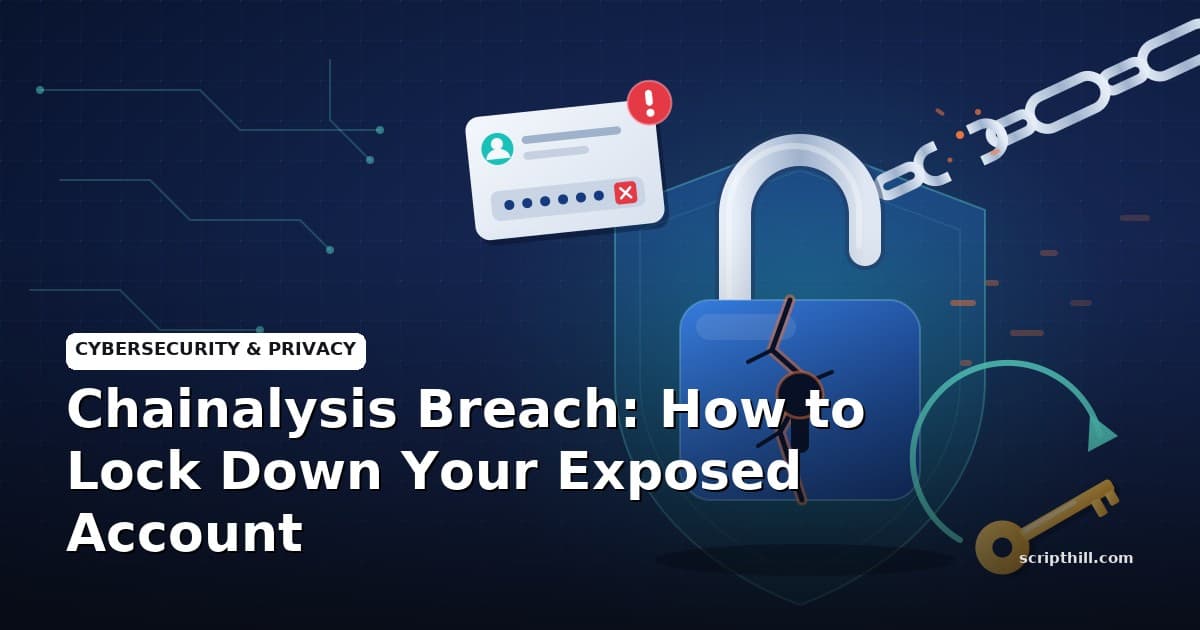
Every Chainalysis user's login is now exposed. In a November 4 update on the Chainalysis breach, the company said names, usernames, password hashes and live tokens for all users had leaked, and that an on-path attack captured a subset of passwords outright. You can't tell whether yours is in that subset, so assume it is.
The tokens are the bigger problem. A live session or API token gets past both your password and MFA until it's revoked, so a password reset won't lock out someone who already holds one. That's why the portal is offline and re-entry runs through an IP allowlist.
Plan for the worst case. On October 30, Chainalysis said it had no evidence that credentials or session tokens were accessed. Within a week, that became "all users."
What the Chainalysis breach exposed
The breach started inside Chainalysis's own systems, not on the customer side. In its October 30 disclosure, the company said an outside attacker used "offensive agentic techniques," meaning AI agents carried out parts of the attack, to reach internal systems and tools. At that point the stolen data was names, email addresses, user IDs and organizational role labels. On November 2, Chainalysis found the exposure went further, and the November 4 update added usernames, password hashes and live tokens for every user. A live token is an active session or API credential that works without the password.
A customer email called the incident an "ongoing multifront cyberattack." One front was an on-path (man-in-the-middle) attack that captured a subset of passwords in transit, and TokenPost reports some leaked in plaintext. Chainalysis says that vector is contained and it has added monitoring. A hash at least makes an attacker work for the password. One grabbed in transit needs no cracking.
Plenty is still unanswered. Chainalysis hasn't said how the captured subset relates to the hashes exposed for everyone, and a spokesperson wouldn't say how many KYT accounts were accessed. The company reports no evidence that investigations data was accessed or attribution data manipulated, and it has promised each customer organization a breakdown of its records.
Get back in through the official channel
KYT and Address Screening come back first, and only for organizations that have told Chainalysis which IP addresses to trust.
-
Send your trusted IP addresses. Email [email protected] or your account team with your organization's egress addresses: office ranges, VPN exits and the servers that call the KYT API. The allowlist is what makes a stolen live token useless, because nobody can reach the service from an address Chainalysis hasn't approved. You'll know it's working when the login page loads from your office or VPN egress IP and nowhere else.
-
Type the login URL yourself. Chainalysis's guidance is to go to the login page directly, never through a link in a reset email. Bookmark it once you're in and use only that bookmark.
-
Set a new, unique password and turn on the strongest MFA offered. Don't use a variation of the old password or one from another account. If you can choose, take an authenticator app or hardware key over SMS. Our guide to rolling out phishing-resistant MFA without lockouts covers making that switch across a team.
-
Reset or close every account nobody personally owns. Shared team logins, service accounts tied to integrations and accounts for staff who've left were all exposed in the same leak. Ask your account team for your organization's active user list, reset every account you still need and close the rest.
Rotate every key and token
Since a password reset does nothing to a stolen token, key rotation belongs on the same day you get back in, not the week after. Work through this list with the integration owner and someone from compliance:
- Rotate every KYT API key and any other Chainalysis keys or tokens your organization has issued. Confirm the old ones are revoked, not just replaced.
- Search code repositories, including commit history, for the old key values. One-off scripts and analyst notebooks are where hardcoded keys usually hide.
- Check environment variables, CI/CD secrets and config files, then redeploy so running services pick up the new key. Our API security checklist covers moving keys into a secrets manager so the next rotation goes faster.
- Match each key to the service account that uses it, so the accounts you reset earlier don't silently break an integration nobody remembered.
- Pull login and KYT API logs going back before the October 30 disclosure. Look for unfamiliar IPs, odd hours and unusual call volumes. Chainalysis says some customer accounts appear to have been accessed without authorization, so record a clean result too.
- Save the per-organization breakdown of affected records when Chainalysis sends it, and file it with your logs and rotation timestamps.
While KYT was offline, transactions either went unscreened or got screened some other way. Write down which fallback controls you used, who approved them, and when they started and stopped. Regulators and auditors will ask about that gap.
Assume your password is known
If you reused your Chainalysis password anywhere else, change it on each of those accounts, starting with the ones that open the door to everything else: your work email, your SSO provider and any crypto exchange logins. Chainalysis also tells users to change reused passwords on other services. A password captured in transit doesn't need cracking, so don't wait. Give each account its own password from a password manager, and turn on MFA wherever it's off.
Expect phishing aimed at you by name. The October 30 leak gave attackers the names, emails and role labels of investigators and compliance staff, and all of those people are now waiting for a genuine password reset. A fake "reset your Chainalysis password" email or a note from "your account team" asking for trusted IPs will look like routine follow-up. Role labels also let attackers pick targets, like the admin who owns the KYT integration or the analyst with Reactor access. Brief your team today, contractors and shared-login users included, and show them these exact lures so they know what to report.
What's still offline or unclear
Most of the platform is still dark. After further abnormal activity, Chainalysis took the login portal, Reactor, Data Solutions, the KYT UI and API, and Address Screening offline, according to BleepingComputer. There's no date yet for Reactor or Data Solutions, so investigators who rely on them should set up workarounds for an open-ended outage.
As of November 9, 2026, Chainalysis hasn't said whether the stolen live tokens were actually used, and it hasn't published its technical report or sent the per-organization breakdowns. Given how fast the scope grew last time, plan for it to widen again and keep your logs, key inventory and phishing briefing ready for another round.
Frequently Asked Questions
I just hold crypto. Am I affected by the Chainalysis breach?
Not directly. Chainalysis sells blockchain analytics to exchanges, banks and agencies. It doesn't hold consumer wallets or retail logins, so your credentials aren't in this leak. Even if your exchange is a Chainalysis customer, the stolen accounts belong to its compliance staff, not to you. Your real risk is scam emails using the news as a hook. No legitimate message will ask for your seed phrase, a wallet connection or a 'security verification' payment.
Is the Chainalysis breach linked to the Binance theft?
Chainalysis says no. Its first disclosure called the intrusion unrelated to the recent Binance theft, but that came before the company learned the exposure was much wider, and nobody has independently confirmed it. Your to-do list is the same either way: rotate your credentials and be suspicious of breach-themed messages.
Sources
- Chainalysis says breach exposed credentials for all customers · bleepingcomputer.com
- Chainalysis Confirms Breach Exposed User Credentials and Passwords · tokenpost.com
- Chainalysis Cyberattack Exposes Users' Credentials, Disrupts Services · analyticsinsight.net
- Chainalysis discloses apparent breach of customers' accounts · americanbanker.com
Want more from ScriptHill in Google? Add us as a preferred source