

The Evolution of Esports: A Technological Journey
The genesis and explosive growth of esports are inextricably linked to the rapid advancements in computing and network technology. What began as informal gatherings around early arcade machines or networked PCs has blossomed into a multi-billion dollar industry, primarily because the underlying technological infrastructure evolved to support its increasing complexity and reach.
In the nascent stages of competitive gaming, the challenges were fundamental. Early skirmishes, like the 1972 "Intergalactic Spacewar Olympics" at Stanford University, were confined to single machines and small, local audiences. The advent of personal computers and arcade cabinets in the late 1970s and 80s expanded the playing field, but true competitive gaming remained localized, often relying on high scores rather than direct player-versus-player interaction. The real catalyst arrived with the development of robust processing power and dedicated graphics hardware. Companies like Intel, AMD, NVIDIA, and ATI (now AMD Graphics) pushed the boundaries, allowing game developers to create increasingly complex, visually rich, and responsive virtual worlds. Without the graphical fidelity and computational speed to render these environments smoothly, the intricate plays and split-second decisions that define modern esports simply wouldn't be possible.
The late 1990s marked a pivotal era with the rise of the local area network (LAN) party. Gamers would haul their bulky desktop towers, CRT monitors, and tangled cables to a single location, connecting them directly via Ethernet. This eliminated the latency issues of early internet connections, fostering intense, real-time competition. Games like Doom, Quake, StarCraft: Brood War, and Counter-Strike became the crucibles where competitive strategies were forged and rivalries ignited. These events, though logistical nightmares by today's standards, were foundational, proving the viability and excitement of head-to-head electronic contests. They built the grassroots communities that would eventually demand a global stage. As legendary game designer John Carmack once put it regarding early multiplayer:
"The only thing that really drives the industry is technology. Everything else is secondary."
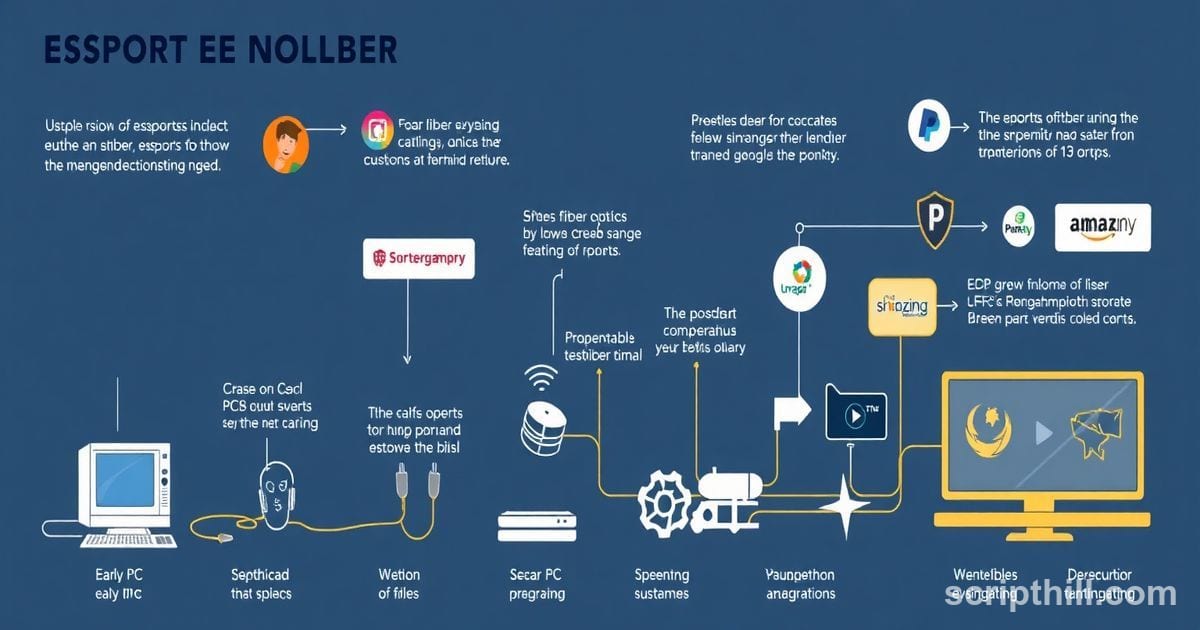
The true explosion of esports, however, was predicated on the widespread adoption of high-speed internet. The shift from slow, unreliable dial-up connections to always-on broadband was a game-changer. Low-latency, stable network infrastructure became the backbone for online competitive play, allowing players from different cities, countries, and even continents to compete against each other in real-time. This eliminated the geographic barriers of LAN parties, paving the way for massive online tournaments and leagues. Key technological developments enabling this included:
- Global Network Infrastructure: The continuous expansion and improvement of fiber optics and data centers reduced ping times and increased bandwidth significantly.
- Sophisticated Game Engines: Engines designed to handle complex client-server interactions, robust netcode, and real-time synchronization.
- Dedicated Servers & Matchmaking Systems: Automated systems that connect players and manage competitive matches, ensuring fair play and reliable connections.
- Anti-Cheat Software: Crucial for maintaining competitive integrity in a global online environment.
This interconnected world fostered the growth of iconic titles like WarCraft III, Dota, League of Legends, and StarCraft II, which were designed from the ground up for online competitive play. The final piece of the puzzle was the rise of live streaming platforms like Twitch, enabled by further advancements in internet speeds and video compression technologies. This transformed esports from a participant-only activity into a global spectator sport. Millions could now watch professional players compete live, fostering fan bases and attracting significant investment, ultimately cementing esports as a legitimate global spectacle driven, at every step, by the relentless march of technological innovation.
Hardware & Network Infrastructure: The Backbone of Competitive Play
The competitive integrity and spectacle of esports are fundamentally underpinned by a sophisticated array of hardware and robust network infrastructure. Without these crucial elements, the split-second decisions and precise executions that define top-tier play would be impossible, dissolving into a frustrating experience of lag and unfair advantages.
High-Performance PCs
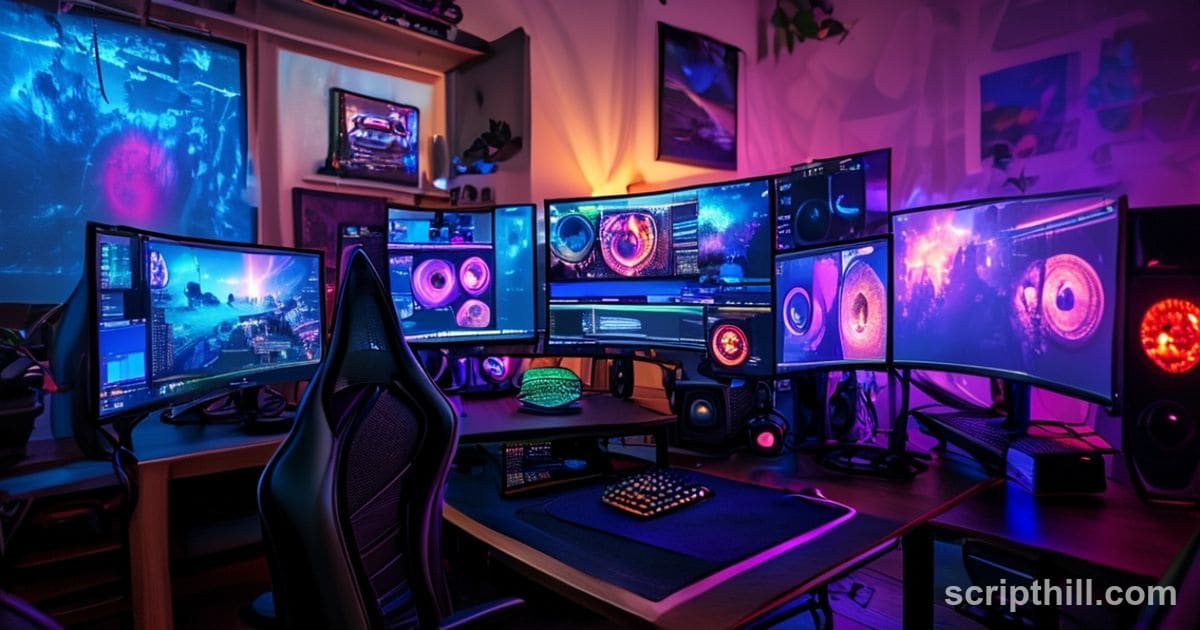
At the heart of professional esports lies the high-performance PC. These machines are purpose-built for gaming, featuring cutting-edge components designed to deliver maximum frame rates and minimal input lag. Key specifications include powerful multi-core processors (e.g., Intel i9 or AMD Ryzen 9 series), top-tier graphics cards (NVIDIA GeForce RTX 40-series or AMD Radeon RX 7000-series) to render complex game worlds at ultra-settings, and ample high-speed RAM (typically 32GB of DDR5). Lightning-fast NVMe Solid State Drives (SSDs) ensure rapid game loading and responsiveness.
Specialized Peripherals
Beyond the raw power of the PC itself, specialized peripherals provide the critical interface between player and game.
- Monitors are perhaps the most vital visual component, offering refresh rates of 144Hz, 240Hz, or even 360Hz paired with ultra-low 1ms response times. Technologies like NVIDIA G-Sync or AMD FreeSync eliminate screen tearing, ensuring a buttery-smooth visual experience.
- Gaming Mice feature high-precision optical sensors, customizable DPI settings, and ergonomic designs to facilitate rapid, accurate cursor movements. Lightweight construction and low lift-off distance are often prioritized.
- Mechanical Keyboards provide consistent, tactile feedback and rapid actuation, crucial for executing complex command sequences quickly. Anti-ghosting and N-key rollover features prevent missed inputs during intense gameplay.
- High-fidelity Headsets with directional audio are essential for spatial awareness, allowing players to pinpoint enemy locations by sound cues alone, often featuring noise-canceling microphones for clear team communication.
Console Gaming's Role
While PCs dominate the upper echelons of esports, consoles like PlayStation and Xbox also host vibrant competitive scenes, particularly for fighting games (e.g., Street Fighter), sports titles (FIFA), and select shooters (Call of Duty). These platforms offer a standardized hardware environment, ensuring a level playing field among competitors, though often with lower graphical fidelity and frame rates compared to high-end PCs.
Server Architecture & Dedicated Gaming Servers
The unseen hero of competitive play is the server architecture and network infrastructure. Dedicated gaming servers, geographically distributed to minimize latency for players worldwide, host game sessions. Unlike peer-to-peer connections, these powerful machines provide a centralized, authoritative source for game state, ensuring fair play and preventing client-side manipulation. Tournament organizers often deploy sophisticated Local Area Network (LAN) setups at events, completely bypassing the public internet to deliver near-zero latency connections for competitors.
| Component Type | Example Specification | Purpose in Esports |
|---|---|---|
| CPU | Intel Core i9-14900K | Raw processing power for game logic and physics |
| GPU | NVIDIA GeForce RTX 4090 | Renders high-fidelity graphics at maximum frame rates |
| RAM | 32GB DDR5-6000MHz | Fast access to game data and multitasking |
| Storage | 2TB NVMe SSD | Ultra-fast game loading and system responsiveness |
Network Infrastructure & Protocols
Low-latency networking protocols are paramount. While the internet relies on the TCP/IP suite, many real-time games prioritize speed over guaranteed delivery, often utilizing User Datagram Protocol (UDP) to transmit critical game state information. This allows for quicker updates, even if a packet is occasionally lost, reducing perceived lag. Robust internet infrastructure, including fiber optic connections, is indispensable for competitive players, providing the necessary bandwidth and stability for online tournaments and practice. Monitoring network performance is a common practice:
# A simple command-line ping to check latency to a game serverping gameserver.example.com
Anti-Cheat Technologies
Finally, anti-cheat technologies are a non-negotiable part of maintaining competitive integrity. These systems operate on both software and hardware levels. Software solutions, such as kernel-level anti-cheat drivers (e.g., Riot Vanguard for Valorant or Easy Anti-Cheat), monitor system processes for known cheating software, analyze player behavior for suspicious patterns, and detect unauthorized modifications to game files. On the hardware side, technologies like Secure Boot and Trusted Platform Modules (TPMs) work to ensure that the operating system boots in a trusted state, making it harder for cheats to inject malicious code at a low level. This constant technological arms race between cheaters and anti-cheat developers is crucial for safeguarding the fairness that esports demands.
Game Engines & Development for Competitive Integrity
Modern esports thrives on a bedrock of competitive integrity, a foundation meticulously crafted within the very game engines that power these virtual arenas. Whether leveraging industry-standard tools like Unreal Engine and Unity, or bespoke custom engines designed for specific gameplay needs, developers optimize their underlying technology to ensure fair play, precise interaction, and consistent performance. This commitment to technical excellence is paramount, as even minor discrepancies can compromise the integrity of high-stakes competition.
At the heart of this optimization lies the fundamental client-server architecture. In most competitive titles, players (clients) send their inputs to a central server, which then processes these actions, updates the game state, and broadcasts the results back to all connected clients. This design prevents cheating by ensuring the server is the ultimate authority on all game logic. Supporting this architecture is robust netcode, the intricate system of algorithms and protocols that manage network communication. Effective netcode prioritizes data transmission, compresses information, and handles packet loss to minimize perceived lag and ensure smooth gameplay, even under less-than-ideal network conditions.
Crucial to responsive gameplay is the tick rate, which defines how many times per second the game server updates the game state. Higher tick rates (e.g., 64-tick or 128-tick servers common in professional FPS games) mean more frequent updates, leading to more accurate player positioning, projectile trajectories, and ultimately, more reliable hit registration. When a player "lands a shot," the server must accurately determine if the hit occurred based on the game state at that precise moment, reconciling the client's perspective with the server's authoritative view.
However, network latency (ping) is an unavoidable reality. To counteract this, modern engines employ sophisticated latency compensation techniques. Instead of waiting for the server to confirm every action, the client often "predicts" outcomes based on player input, allowing for a more immediate feeling of responsiveness. When the server eventually validates the action, it might "rewind" the game state slightly to confirm if a hit would have occurred from the client's perspective at the time of input, even if the target had since moved on the server's current timeline. This delicate balance ensures that players with varying latencies can still experience fair and consistent interactions.
The development challenges in crafting esports-ready titles are substantial, demanding a specific design philosophy focused on competitive health:
- Deterministic Simulation: Ensuring that given the same inputs, the game state evolves identically across all machines (and the server) is vital for replay accuracy and fair play.
- Performance Scaling: Games must perform consistently across a wide range of hardware, allowing competitive parity without requiring bleeding-edge PCs.
- Anti-Cheat Integration: Robust anti-cheat systems are non-negotiable, requiring continuous updates to combat evolving methods of exploitation.
- Input Precision: Minimizing input lag and ensuring every player action is registered accurately is fundamental.
As one developer aptly put it:
"Competitive integrity isn't just a feature; it's a constant commitment. Every design choice, every line of netcode, every patch is scrutinized through the lens of fairness and balance."
This commitment extends far beyond a game's initial launch. The longevity and competitive health of an esport title are heavily reliant on ongoing patches and updates. These can range from critical bug fixes that prevent exploits to subtle balance adjustments for characters, weapons, or abilities that have proven too strong or too weak in competitive play. Crucially, community feedback plays an indispensable role here. Professional players, content creators, and the wider player base offer invaluable insights, often identifying meta shifts or unforeseen interactions that developers then address. This iterative process of listening, analyzing, developing, and deploying updates ensures the game remains fresh, balanced, and equitable, fostering a dynamic competitive environment that rewards skill and strategic mastery over technological advantage or broken mechanics.
Broadcast, Streaming & Fan Engagement Technologies
The global appeal of esports isn't solely built on competitive skill; it's also a testament to the sophisticated technological infrastructure that brings these digital battles to millions worldwide. From dedicated streaming platforms to cutting-edge broadcast production, every facet is designed to maximize viewer engagement and deliver a premium spectating experience.
Live Streaming Platforms
At the heart of esports dissemination are live streaming platforms like Twitch and YouTube Gaming. These platforms serve as the primary conduits, allowing fans to tune into live tournaments, individual player streams, and community events from any internet-connected device. Twitch, in particular, has become synonymous with esports, offering robust chat functionalities, custom emotes, and subscriber benefits that foster vibrant communities around streamers and teams. YouTube Gaming leverages its existing global video infrastructure, often hosting major tournament streams and providing unparalleled VOD (Video on Demand) accessibility post-broadcast, ensuring fans can catch up on missed action anytime.
Professional Broadcast Production
Behind the polished streams lies a professional broadcast production pipeline mirroring traditional sports, yet tailored for the unique demands of competitive gaming. Production teams utilize an array of high-definition cameras, sophisticated audio mixing boards, and control room setups to manage multiple video feeds, commentator microphones, and crucial in-game sound effects. Unlike traditional sports, much of the "action" originates within the game itself, requiring specialized software and skilled operators to capture the most impactful moments from dynamic virtual environments.
Real-Time Data Overlays and Visualization
A critical enhancement to the viewer experience comes from real-time data overlays and graphical interfaces. These dynamic elements provide crucial information, from player statistics and team scores to intricate in-game economy breakdowns or character ability cooldowns. Advanced graphics engines integrate directly with game APIs, allowing for instantaneous updates that help both casual and hardcore viewers understand the unfolding strategy and individual performances.
| Overlay Type | Purpose | Example Game |
|---|---|---|
| Scoreboard | Displays current match score, game timer, team names, and player KDA | League of Legends, CS:GO, Dota 2 |
| Minimap/Radar | Shows player positions, objective status, and fog of war | Valorant, StarCraft II |
| Player POV Feed | Allows viewers to see a specific player's screen in real-time | Call of Duty, Apex Legends |
| Team Net Worth | Tracks economic advantage and resource accumulation between teams | Dota 2, League of Legends |
| Ability Timers | Indicates when a player's ultimate abilities or key spells are ready | Overwatch, Heroes of the Storm |
AR and VR Integrations for Spectating
Augmented Reality (AR) and Virtual Reality (VR) are steadily making inroads into esports spectating, promising more immersive experiences. AR can project 3D models of in-game characters onto physical stages during live events, or display interactive statistics floating above players in a live venue. VR, while still niche, offers the potential for viewers to "step inside" the game world, watching matches from a virtual arena seat or even from within the game map itself, observing character movements and spell effects up close from an entirely new perspective.
Dedicated Observer Tools and Replay Systems
Dedicated observer tools are paramount for high-quality esports broadcasts. These are specialized in-game clients that allow production staff to move the camera freely, switch player perspectives, highlight specific actions, and generally dictate the visual narrative of a match without interfering with gameplay. Paired with robust replay systems, these tools enable broadcasters to instant replay clutch plays, analyze pivotal moments in slow motion, and provide telestrated breakdowns, dissecting strategies just like a traditional sports pundit analyzes a touchdown. This ensures that no critical moment is missed and every strategic decision can be thoroughly examined.
Interactive Fan Engagement
Esports broadcasts excel in fostering immediate fan interaction, creating a dynamic, participatory environment that transcends passive viewing. Key features include:
- Live Chat: Real-time communication with other viewers, streamers, and sometimes even commentators, creating a sense of shared experience.
- Polls & Predictions: Engaging viewers with questions about upcoming match outcomes or in-game events, often with virtual rewards.
- Channel Points/Bits: Twitch's proprietary virtual currency allowing viewers to "cheer" for teams, unlock special emotes, or trigger on-screen effects.
- Extensions: Third-party overlays providing real-time stats, bracket updates, or interactive mini-games directly on the stream interface.
- Drops: In-game items or currency awarded to viewers for watching specific official streams, incentivizing viewership.
These technologies collectively transform competitive gaming into a global spectacle, continuously pushing the boundaries of how fans connect with their favorite teams and players. The relentless innovation in broadcast and engagement tools ensures that esports remains at the forefront of digital entertainment.
Data Analytics, AI & Performance Optimization
The modern esports arena is no longer solely about raw talent and lightning reflexes; it's increasingly a battleground of algorithms and analytical prowess. Data science and artificial intelligence have emerged as indispensable tools, fundamentally reshaping how professional teams and individual players approach performance, strategy, and talent acquisition.
At the heart of this transformation is in-game analytics, an incredibly granular system for tracking player performance. Every action, every decision made within a match, from a crucial last-hit in a MOBA to a precise grenade throw in an FPS, generates data. This trove of information allows teams to construct comprehensive individual player profiles, highlighting strengths and pinpointing weaknesses with scientific precision. For instance, in titles like League of Legends or Dota 2, metrics extend far beyond simple Kill/Death/Assist (KDA) ratios. Teams analyze:
- Creep Score (CS) per minute: Efficiency in resource acquisition and farming.
- Vision Score: How well a player controls map vision, crucial for strategic play and information denial.
- Damage dealt/taken ratios: Indicators of player aggression, target prioritization, and survivability.
- Objective control rate: Contribution to securing key map objectives like dragons, baros, or bomb sites.
- Reaction time and accuracy: Especially critical in fast-paced first-person shooters, measured in milliseconds and hit percentages.
This detailed feedback empowers players to refine their mechanics and decision-making, converting raw data into actionable insights for improvement.
Beyond individual play, data analytics drives sophisticated strategic analysis for teams. AI models can process vast amounts of historical match data to identify optimal team compositions, predict opponent tendencies based on draft picks, or even suggest real-time adjustments to macro-strategy during a live match. Coaches use these tools to dissect team fights, analyze rotation patterns, and understand objective priority, turning subjective observations into verifiable facts. This data-driven approach minimizes guesswork, allowing teams to develop robust game plans tailored to specific opponents or evolving metas.
AI-powered coaching systems take this a step further, offering personalized guidance that complements human coaching. These systems can observe a player's gameplay patterns over hundreds of matches, identifying subtle habits, inefficiencies, or mechanical inconsistencies that a human coach might overlook due to the sheer volume of data. They can then recommend tailored training exercises, specific VODs to review, or even simulate scenarios to practice decision-making under pressure. Some advanced systems provide real-time feedback during practice sessions, highlighting missed opportunities or suboptimal plays as they happen.
A critical application of this technology is opponent analysis. Before a major match, teams leverage AI to deep-dive into their rivals' playbooks. By analyzing past matches, AI can uncover preferred champion pools, typical item builds, lane assignments, jungle pathing, and even common aggression timings. This allows a team to anticipate their opponent's strategies and prepare targeted counter-strategies, giving them a significant edge. Imagine knowing a specific player's tendency to flash aggressively early in a particular matchup—this insight, derived from data, can be the difference between victory and defeat.
Finally, predictive modeling for player recruitment is revolutionizing how organizations scout talent. Instead of relying solely on subjective scouting reports or high-level public ladder performance, AI algorithms can analyze a player's raw in-game statistics, growth trajectories, and even their temperament (derived from comms data, if available) to forecast their potential and how well they might integrate into a specific team dynamic. This data-driven scouting minimizes the risk associated with investing in new talent. A simplified example of how a model might evaluate a player could look like this:
def predict_player_potential(stats_data):"""Predicts a player's potential based on key performance indicators (KPIs).This is a highly simplified illustrative function."""kda_weight = 0.3cs_per_min_weight = 0.2vision_score_weight = 0.15objective_control_weight = 0.2accuracy_weight = 0.15 # Relevant for FPS gamespotential_score = (stats_data['kda'] * kda_weight +stats_data['cs_per_min'] * cs_per_min_weight +stats_data['vision_score'] * vision_score_weight +stats_data['objective_control'] * objective_control_weight +stats_data['accuracy'] * accuracy_weight)return potential_score
This blend of statistical analysis and machine learning empowers esports organizations to operate with unprecedented strategic depth, transforming the competitive landscape into a sophisticated interplay of human skill augmented by cutting-edge technology.
The Future of Esports Technology: Innovation on the Horizon
The technological current driving esports is relentless, promising to reshape how games are played, watched, and governed. Innovation isn't merely incremental; it’s poised to introduce entirely new paradigms for competitive interaction and fan engagement.
Cloud Gaming: Bridging the Accessibility Divide
Cloud gaming platforms are rapidly maturing, offering the potential to dramatically lower the barrier to entry for aspiring esports athletes. By offloading demanding hardware requirements to remote servers, competitive play can become accessible to anyone with a stable internet connection, regardless of their local computing power. This democratization extends the talent pool globally, potentially uncovering hidden esports stars in regions previously constrained by hardware costs. Furthermore, cloud gaming ensures a standardized, high-performance environment for tournaments, eliminating discrepancies caused by varied participant setups. The biggest hurdle remains achieving ultra-low latency, but advancements in network infrastructure and streaming protocols are continually pushing these boundaries, making real-time, competitive gameplay a smoother experience.
Advanced VR/AR: Immersive Play and Unprecedented Spectating
Virtual Reality (VR) and Augmented Reality (AR) are set to revolutionize both the playing field and the spectator experience. For competitive play, purpose-built VR esports are already emerging, demanding new skills in spatial awareness, physical dexterity, and reaction time within fully immersive digital worlds. As haptics and motion tracking improve, these games will offer unparalleled depth.
However, the more immediate impact on established esports titles might be in spectating. Imagine:
- Being "inside" the game: Viewers could experience matches from any player's perspective, or even a free-roaming camera, in a 360-degree virtual stadium.
- Augmented overlays: Real-time statistics, player health bars, and tactical maps could be overlaid directly onto the live gameplay environment, enriching understanding.
- Social spectating: Fans could gather in virtual lounges, interacting with friends and other viewers in a shared immersive space while watching a match unfold.
These advancements promise a level of immersion that traditional broadcasts simply cannot replicate, transforming passive viewing into an active, personalized experience.
Blockchain Technology: Redefining Digital Ownership and Governance
Blockchain technology is poised to introduce fundamental shifts in esports ecosystems, primarily through verifiable digital ownership and decentralized governance. Non-fungible tokens (NFTs) can represent unique in-game assets like skins, character models, or rare items, providing players with true ownership that can be traded, sold, or even carried across different games. This creates robust, player-driven economies with transparent transaction histories.
The implications extend further to fan engagement and team management:
- True digital ownership: Players can verifiably own rare in-game items or even unique player cards, fostering vibrant secondary markets.
- Decentralized finance (DeFi): Integration of crypto rewards, staking, and decentralized autonomous organizations (DAOs) could give fans and players a direct financial stake in the success of games or teams.
- Fan governance: Blockchain-based fan tokens could empower communities to vote on critical decisions, from team branding and roster changes to prize pool distribution and competitive rule adjustments, fostering unprecedented levels of engagement and loyalty. This paradigm shift could move esports closer to a truly community-led model.
The Evolution of AI: Smarter Games, Fairer Play, Better Athletes
Artificial intelligence continues its profound impact, evolving beyond simple opponent AI to influence every facet of esports. In game design, AI can generate dynamic content, from procedurally created maps and challenges tailored to a player's skill level, to entire adaptive game modes that keep experiences fresh and engaging.
For competitive integrity, AI is becoming the vanguard against cheating. Sophisticated AI algorithms can analyze behavioral patterns, movement anomalies, and input timings in real-time, detecting even the most subtle forms of cheating that traditional signature-based systems might miss. This proactive, intelligent anti-cheat system is crucial for maintaining a fair playing field.
Furthermore, AI is set to revolutionize player development. Imagine personalized AI coaches that analyze your gameplay, identify weaknesses, and recommend specific training regimens or drills. As one industry analyst put it, "AI will transform raw talent into optimized performance, not just through analysis, but through prescriptive, individualized growth pathways that were previously unimaginable." This personalized approach promises to unlock new levels of skill and tactical understanding, pushing the boundaries of what professional players can achieve.
These converging technologies paint a vibrant picture of an esports landscape far more accessible, immersive, transparent, and intelligent than what we know today. The pace of innovation suggests that many of these advancements are not distant dreams but rather imminent realities.

