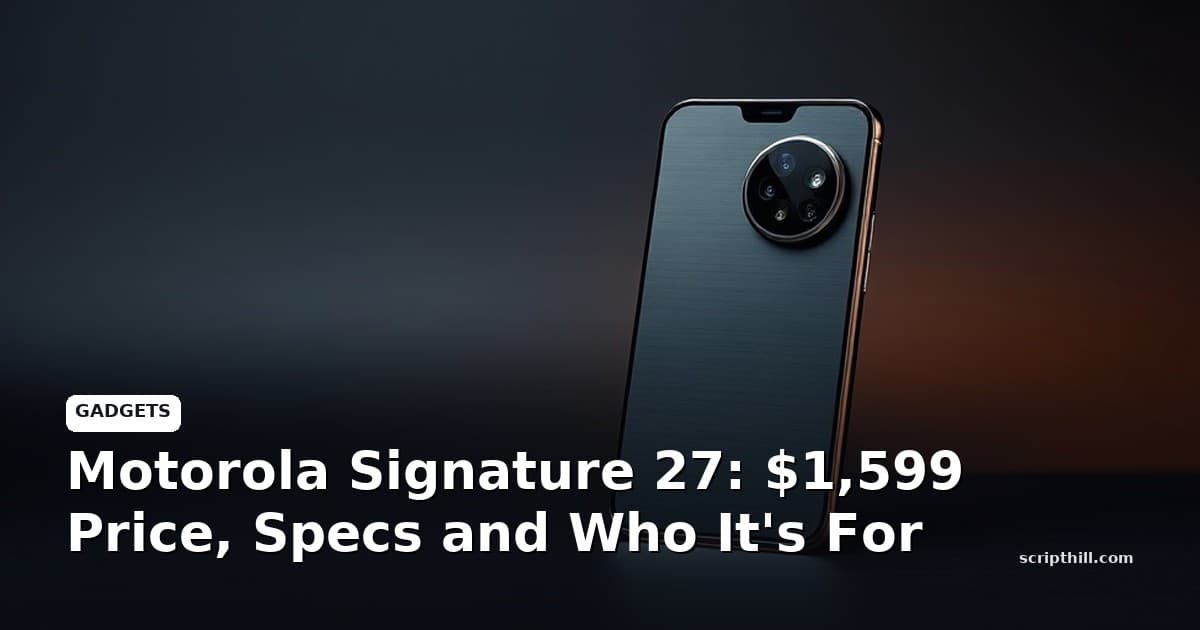
Motorola launched the Signature 27 globally on November 5, 2026, after first showing it during Qualcomm's Snapdragon Summit keynote on September 23. As of November 2026, the Motorola Signature 27 costs $1,599.99 in the US in a single 12GB RAM and 512GB storage configuration, and it's on sale in the US, Europe, the Middle East and Africa.
Three features lead the launch: the Snapdragon 8 Elite Extreme Gen 6 chip, a 200MP periscope telephoto camera and a 7,000mAh silicon-carbon battery.
Spec sheets settle only part of the case. Sustained chip speed and low-light zoom quality still depend on reviews, and India pricing awaits an official announcement. What follows separates confirmed facts from open questions and sorts buyers into those who should order now, wait or skip.
Signature 27 launch timeline
As of November 2026, Motorola has confirmed every step of the rollout except the Indian one.
- September 23, 2026: Motorola unveiled the Signature 27 during Qualcomm's Snapdragon Summit keynote, where 91mobiles called it the first phone announced with the Snapdragon 8 Elite Extreme Gen 6, while Engadget more cautiously described it as "among the first."
- November 5, 2026: The global launch began across Europe, the Middle East, Africa and the US.
- Week of November 5, 2026: Motorola announced a North American price of $1,599.99.
- Later in November 2026 (reported, not officially confirmed by Motorola): NewsBricks reports an India launch this month, though no Indian price or exact date has surfaced yet.
Price, configuration and where you can buy it
The Motorola Signature 27 costs $1,599.99 in the US, and the only North American configuration pairs 12GB of RAM with 512GB of storage, according to AndroidHeadlines' launch report. No microSD slot is listed, so 512GB is the most storage the phone will ever have. Buyers who plan to shoot a lot of high-resolution telephoto photos and video should budget for cloud backup or regular offloading.
The phone is on sale in Europe, the Middle East, Africa and the US. As of November 2026, launch coverage hasn't confirmed European pricing, any other storage tiers or which carriers will stock it, so anyone buying through a carrier plan should check with their provider before ordering. The price itself is the bigger story. The first Signature sold for roughly $800 to $1,200 depending on configuration, which kept it below the Ultra and Pro tier. At $1,599.99, Motorola is asking top-of-market money for a brand that has rarely charged it.
Motorola Signature 27 full specs
Launch coverage from AndroidHeadlines' report on the Signature 27's US price and core specs and other outlets supports the following spec sheet, as of November 2026.
| Spec | Signature 27 |
|---|---|
| Chip | Qualcomm Snapdragon 8 Elite Extreme Gen 6 |
| Display | 6.8-inch tandem LTPO OLED ("Extreme AMOLED Duo"), up to 120Hz, up to 12,000 nits peak; some reports list 6.78 inches and 1.5K resolution |
| RAM and storage | 12GB / 512GB (only North American configuration) |
| Expandable storage | No microSD slot |
| Main camera | 50MP Sony LYTIA 910, 1/1.28-inch sensor |
| Telephoto | 200MP periscope |
| Ultra-wide | 50MP |
| Additional sensor | "Action" sensor (described as triple-plus-action or quad, depending on the report) |
| Battery | 7,000mAh silicon-carbon |
| Wired charging | 90W |
| Wireless charging | 50W |
| Magnetic charging | Not listed |
| Headphone jack | Not listed |
| Cooling | ArcticMesh, with a vapor chamber 40% larger than the previous generation's |
| Audio | "Audio by B&O," the first product of Motorola's Bang & Olufsen partnership |
| Software | Android 17, seven OS upgrades, up to seven years of security updates |
| Colors | Pantone Coal Smoke, Pantone Capulet Olive (textured back) |
| US price | $1,599.99 |
Reports disagree on three points: the display size (6.78 or 6.8 inches), whether the camera array counts as triple or quad, and whether the second color is Capulet Olive or Capulet Green. Motorola's official spec page settles all three.
What the Snapdragon 8 Elite Extreme Gen 6 actually adds
Qualcomm launched two flagship chips together this cycle: the standard Snapdragon 8 Elite Gen 6 and the Extreme Gen 6, which 91mobiles' launch report describes as the more powerful of the pair. For Motorola, the jump is bigger than the name suggests. The original Signature ran the Snapdragon 8 Gen 5, a tier below the 8 Elite Gen 5, so the Signature 27 moves up two chip tiers in one generation. NewsBricks reports that the Extreme Gen 6 is built on a 2nm process and peaks at 5.01GHz. As of November 2026, those figures haven't been confirmed against an official Qualcomm spec sheet, so they should be treated as reported rather than settled.
Peak clocks are the easy part. Almost any flagship can hit its top frequency for a few seconds. What matters is the speed a phone can hold deep into a long gaming session or a lengthy 4K video export, once heat builds and the chip throttles to protect itself. Motorola's answer is ArcticMesh cooling, built around a vapor chamber 40% larger than the previous generation's. Some coverage also calls it "diamond-infused." On paper, that's the right fix for a chip tuned to run hotter.
How well it works in practice is still unknown. The useful review data will be looped stress tests that report how much performance the phone keeps between the first run and the last, frame-rate graphs from extended play, and surface temperatures under load. Head-to-head runs against standard 8 Elite Gen 6 phones matter most. Until those results publish, there's no basis for saying "Extreme" makes the Signature 27 meaningfully faster in daily use.
Is a 200MP periscope telephoto better, or just a bigger number?
The periscope telephoto jumps from 50MP on the first Signature to 200MP, according to Engadget's launch coverage. Pixel count alone doesn't decide zoom quality, though. A 200MP sensor mainly gives the phone room to crop. When a shot needs more reach than the lens provides optically, the phone can use only the center of the frame and still have enough pixels left for a detailed image. That adds usable zoom steps without heavy digital upscaling, and it works best in daylight, when each of those tiny pixels gets plenty of light.
At night, phones usually do the opposite. They bin pixels, merging groups of neighboring pixels into one larger pixel that collects more light and produces less noise. The trade-off is lower resolution. How well binning works depends on the physical size of the sensor and on the phone's image processing. As of November 2026, Motorola hasn't confirmed how big the telephoto sensor is. A high megapixel count on a small sensor can still produce muddy low-light zoom.
The main camera isn't the story here. It appears to be the same 50MP Sony LYTIA 910 at 1/1.28-inch, which Engadget calls "relatively unchanged." That puts nearly all of the camera upgrade in the telephoto. Daylight zoom is the likely improvement. Night zoom remains unproven until reviewers publish side-by-side samples.
The display and battery numbers, decoded
The screen measures 6.8 inches and uses a tandem OLED panel, which stacks two light-emitting layers instead of one. Motorola brands it "Extreme AMOLED Duo." Because two layers share the work, each can typically run less hard for the same output. The panel is also LTPO, so it can lower its refresh rate on static content and raise it to 120Hz for scrolling and games. The headline 12,000 nits is a peak figure. It applies to small highlight areas, such as a sun glint in an HDR video, not to the whole screen at once. Brands measure peak and full-screen brightness differently, so putting 12,000 nits next to another phone's full-screen number says little. Outdoor readability depends on sustained brightness, which reviewers haven't measured yet.
The battery is the more concrete win. AndroidHeadlines lists a 7,000mAh silicon-carbon cell with 90W wired and 50W wireless charging. Silicon-carbon cells hold more capacity than conventional cells of a similar size, which is how Motorola fits that number into a flagship-sized body. Combining that capacity with 50W wireless charging is unusual among US flagships, and it's likely the phone's most practical edge. There's one catch: reaching 90W wired or 50W wireless requires a compatible charger, and ordinary pads and older bricks will charge more slowly.
Signature 27 vs the original Signature
| Model | Chip | Telephoto | Main camera | Cooling | Audio | US price |
|---|---|---|---|---|---|---|
Motorola Signature | Snapdragon 8 Gen 5 | 50MP | Sensor largely carried over to the new model | Previous-generation vapor chamber | No B&O branding | About $800 to $1,200, by configuration |
Motorola Signature 27 | Snapdragon 8 Elite Extreme Gen 6 | 200MP periscope | 50MP Sony LYTIA 910, 1/1.28-inch; largely unchanged | ArcticMesh, 40% larger vapor chamber | "Audio by B&O" | $1,599.99 (12GB/512GB only) |
The chip and zoom upgrades are real. The original Signature used Qualcomm's lower-tier Snapdragon 8 Gen 5 rather than the 8 Elite Gen 5. Moving to the top Extreme chip is a larger jump than a normal yearly refresh, and the telephoto's resolution goes from 50MP to 200MP. The main camera is another story: Engadget describes it as relatively unchanged. The B&O audio tuning still needs reviews to show whether it sounds better. At $1,599.99 as of November 2026, the Signature 27 sits in Samsung Ultra and Google Pixel Pro territory, where buyers expect every spec to be top-tier, not just two. Owners who paid around $800 for the first model would be paying roughly twice as much.
Android 17, Gemini and the seven-year update promise
The Signature 27 ships with Android 17, and Motorola is promising seven OS upgrades and up to seven years of security updates. That puts it among the longest support commitments in Android. Gemini is built in, including Omni for video generation and Lyria for music generation. Reviews will show how useful those tools are in daily use. A spec sheet can't.
The problem is Motorola's record. The company's update speed has been criticized for years, so buyers paying $1,599 are trusting a promise rather than a track record. Long support does make it more reasonable to keep the phone for four or five years. It should also help resale value, because a used handset with years of patches left is easier to sell. Both benefits depend on upgrades arriving on time. A seven-year pledge that is delivered months late in each cycle is worth much less than the headline number suggests.
How it stacks up against Galaxy, Pixel and other 8 Elite Gen 6 phones
At $1,599, the Signature 27 sits in the same price bracket as Samsung's Galaxy Ultra and Google's Pixel Pro lines, a tier Motorola hasn't seriously contested in years. That puts it up against advantages a spec sheet can't show. Samsung and Google have stronger brand pull, typically better resale value, aggressive carrier promotions and wide in-store support. They also have a longer record of actually delivering the updates they promise. Carrier deals and trade-ins can narrow the real price gap quickly, and as of November 2026, Motorola offers only one 12GB/512GB configuration in North America.
On paper, Motorola leads in several places buyers notice daily. A 7,000mAh silicon-carbon battery with 50W wireless charging is rare among US flagships and is probably the phone's clearest practical advantage. The seven-OS-upgrade pledge matches the longest commitments in Android, and the 200MP periscope gives Motorola a credible zoom story. Whether that zoom holds up against established camera leaders in dim light is a question for reviews.
The chip is a weaker argument. Phones running the standard 8 Elite Gen 6 may feel just as fast in everyday use if their cooling is good, so the "Extreme" label alone doesn't justify paying more. Availability is a stronger one. Chinese flagships pairing similar silicon with large batteries often aren't sold through US carriers. For American buyers who want that combination with carrier compatibility and local warranty support, Motorola is one of the few options.
India launch: what's known so far
Should you buy it, wait or skip it?
The decision depends on which unknowns a buyer can tolerate, because several of the most important questions about this phone don't have answers yet.
Buy now: US buyers who want a 7,000mAh silicon-carbon battery, 50W wireless charging, a 200MP periscope telephoto and seven OS upgrades from a locally sold Android phone have few alternatives. The trade-off is paying the full $1,599.99 for the only North American configuration, 12GB RAM with 512GB storage.
Wait: Reviews haven't yet measured sustained gaming performance or low-light zoom. The larger ArcticMesh vapor chamber only helps if it keeps the Extreme Gen 6 near peak speed under long loads. Indian buyers have no price or configuration to judge yet, so waiting for the later-November launch costs them nothing.
Skip: There's no microSD slot, so 512GB is the permanent ceiling. Buyers who care most about resale value and carrier deals, or who doubt Motorola's update record at this price, have safer options in the Galaxy Ultra and Pixel Pro lines.
Early buyers should confirm the retailer's return window before ordering, since thermal and camera reviews will only appear after the phone ships.
Before you order: a quick checklist
A few checks are worth running before placing a $1,599.99 order, as of November 2026.
- Confirm the carrier supports the Signature 27 on its network.
- Look for trade-in credit and launch offers from Motorola, carriers and retailers.
- Check that existing chargers support 90W wired and 50W wireless charging, or budget for new ones.
- Decide whether the single 12GB/512GB configuration is enough, since there's no microSD slot.
- Check Motorola's official spec page for display size, camera count and color names, where early reports conflict.
Frequently Asked Questions
Why is it called the Motorola Signature 27?
The "27" points to the coming year, not a model count. Motorola uses the last two digits to signal the year ahead, so a phone launched in late 2026 carries 2027 branding. Fossbytes reports that it's only the second phone in the Signature line, which means buyers shouldn't read the number as a sign of 26 earlier versions.
Is the Signature 27 the first phone with the Snapdragon 8 Elite Extreme Gen 6?
It was at least one of the first, and possibly the very first. Motorola showed the phone on stage at Qualcomm's Snapdragon Summit keynote on September 23, 2026. Coverage from that event differs on the exact claim. 91mobiles called it the first phone announced with the chip, while Engadget used the more careful wording "among the first." Being first to announce a chip also doesn't guarantee being first on store shelves.
Does the Motorola Signature 27 have a headphone jack?
None of the launch coverage lists a 3.5mm headphone jack, and Motorola hasn't advertised one. That fits the pattern of most current flagships, which leave the port out. Buyers who rely on wired headphones should plan on a USB-C adapter, USB-C earbuds or Bluetooth audio unless Motorola's official spec page says otherwise. Since the phone's audio is tuned with Bang & Olufsen, wireless listening is likely where Motorola expects most people to use it.
Does the Motorola Signature 27 support magnetic charging?
Magnetic charging isn't listed in any launch report so far, so it shouldn't be counted on. The phone does support fast 50W wireless charging, but that is a separate feature from a built-in magnetic ring for snap-on chargers and accessories. Without magnets in the phone, magnetic accessories would need a case with a magnetic ring to stay attached, and a standard pad won't hold the phone in place or reach the full 50W speed.
The bottom line on the Signature 27
The Signature 27's strongest confirmed case rests on two things. The first is a 7,000mAh silicon-carbon battery with 90W wired and 50W wireless charging, a combination that's rare among US flagships. The second is Android 17 with seven OS upgrades and up to seven years of security updates. The battery is already on the spec sheet. The update promise depends on Motorola shipping patches on time for years, and its track record doesn't guarantee that. What $1,599.99 doesn't yet buy is evidence that the Extreme Gen 6 holds its speed under sustained load, or that the 200MP periscope stays sharp in low light.
As of November 2026, three developments matter: reviews covering heat throttling and camera quality, Indian pricing expected later this month, and European pricing that Motorola hasn't published. US buyers who want a 7,000mAh battery and long software support, and who are content with a single 512GB configuration, can order now. Indian buyers and long-session gamers should wait a few weeks for those results.
Sources
- Motorola Signature 27 unveiled with Snapdragon 8 Elite Extreme Gen 6, 200MP periscope telephoto and more · 91mobiles.com
- First to be unveiled with the Snapdragon 8 Elite Extreme Gen 6, Motorola's Signature 27 is official - PhoneArena · phonearena.com
- Motorola's new Signature 27 is among the first smartphone to use the Snapdragon 8 Elite Extreme Gen 6 processor - Engadget · engadget.com
- Motorola Signature 27 Is Official With the Snapdragon 8 Elite Extreme Gen 6 and a $1,599 Price Tag · androidheadlines.com
Want more from ScriptHill in Google? Add us as a preferred source