

The Imperative for Clean Energy
The transition to clean energy is not merely an option; it is an urgent, multifaceted imperative driven by the profound challenges facing our planet and its inhabitants. At its core, clean energy refers to power generated from sources that produce minimal to zero greenhouse gas emissions and other pollutants during operation. This focus on environmental impact and emissions profile is what fundamentally distinguishes it. While most clean energy sources are also renewable – meaning they replenish naturally on a human timescale, such as solar, wind, hydroelectric, and geothermal power – not all renewables are perfectly clean (e.g., some forms of biomass combustion can produce significant air pollution), and conversely, some non-renewable sources like nuclear power are considered clean due to their near-zero operational emissions. The critical distinction lies in the resultant ecological footprint.
The global context demanding this shift is stark and undeniable. Firstly, climate change stands as the most existential threat of our era. The burning of fossil fuels – coal, oil, and natural gas – has released colossal quantities of greenhouse gases into the atmosphere, trapping heat and accelerating global warming. The scientific consensus is clear: rising global temperatures are triggering more frequent and intense extreme weather events, from devastating droughts and wildfires to severe floods and superstorms, alongside glacial melt, sea-level rise, and ocean acidification. The window for effective action is rapidly narrowing, making the decarbonization of our energy systems an absolute necessity to avert catastrophic and irreversible environmental damage.
Secondly, the pervasive fossil fuel dependency poses significant risks beyond environmental degradation. These finite resources are subject to volatile global markets, influenced by geopolitical tensions and supply chain disruptions, leading to unpredictable energy prices and economic instability. Furthermore, the extraction, processing, and transportation of fossil fuels are inherently destructive, causing widespread ecological damage, including habitat destruction, water contamination, and air pollution, often disproportionately affecting vulnerable communities. This dependency also fuels geopolitical conflicts and entrenches an uneven distribution of power, with resource-rich nations wielding immense influence.
The urgent need for a sustainable energy transition therefore emerges not just as an environmental plea, but as a critical strategy for global stability, public health, and economic resilience. Embracing clean energy offers a transformative pathway, unlocking a cascade of benefits:
- Environmental Protection: Drastically reduced greenhouse gas emissions combat climate change, while cleaner air and water preserve biodiversity and improve ecosystem health.
- Public Health Improvements: Less air pollution translates directly to lower rates of respiratory illnesses, heart disease, and premature deaths, significantly improving global public health outcomes and reducing healthcare burdens.
- Energy Security and Independence: Nations can reduce their reliance on foreign energy suppliers, enhancing national security and economic autonomy.
- Economic Growth and Innovation: The clean energy sector is a burgeoning source of job creation in manufacturing, installation, research, and development, fostering innovation and creating new industries.
As former UN Secretary-General Ban Ki-moon eloquently put it, "Sustainable energy is the golden thread that connects economic growth, social equity, and environmental sustainability." This transition is not merely about replacing one fuel source with another; it's about fundamentally reshaping our economies and societies for a healthier, more equitable, and secure future.
Core Clean Energy Technologies Explained
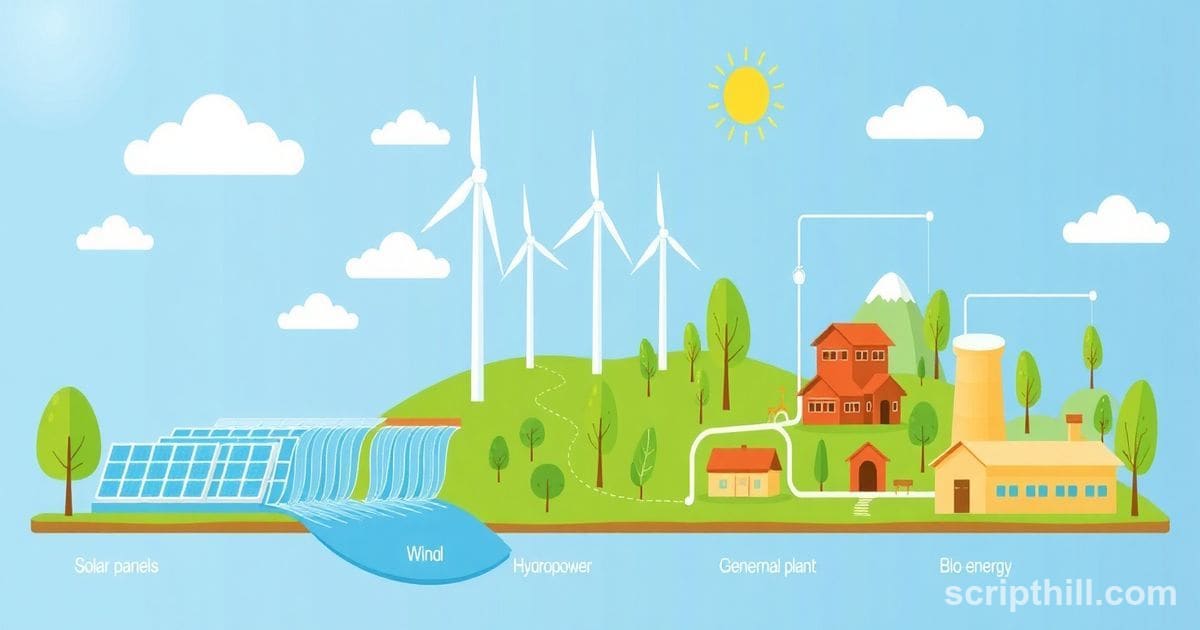
Harnessing the Earth's natural processes, clean energy technologies convert renewable resources into usable power with minimal environmental impact. Understanding their operational mechanisms, current deployment, benefits, and challenges is crucial for appreciating their role in a sustainable future.
Solar energy taps into the sun's radiant power, primarily through two distinct methods:
-
Photovoltaic (PV) Systems:
- Operating Principles: PV panels consist of semiconductor materials, most commonly silicon, that exhibit the photovoltaic effect. When photons from sunlight strike the material, they excite electrons, creating an electric current. This direct current (DC) is then converted to alternating current (AC) by an inverter for grid compatibility.
- Current State: PV technology dominates the solar market, with widespread deployment from residential rooftops to vast utility-scale solar farms. Significant cost reductions and efficiency improvements (e.g., over 20% for commercial silicon panels) continue to drive its rapid expansion.
- Advantages: Abundant and freely available energy source, zero operational emissions, scalable from small devices to large grids, and rapidly falling installation costs.
- Limitations: Intermittency due to night, clouds, and seasonal variations; requires energy storage for continuous supply; land-intensive for large-scale projects; material sourcing and recycling considerations.
-
Concentrated Solar Power (CSP):
- Operating Principles: CSP systems use mirrors (e.g., parabolic troughs, heliostats) to focus sunlight onto a receiver. This concentrated sunlight heats a fluid (like molten salt), which then generates steam to drive a conventional turbine and produce electricity. Many systems integrate thermal energy storage.
- Current State: Less prevalent than PV, CSP is typically deployed in large utility-scale projects, particularly in regions with high direct normal irradiance (DNI). Its ability to store heat allows for dispatchable power generation, even after sunset.
- Advantages: Can provide dispatchable power with integrated thermal storage, higher capacity factors than PV without storage, and a smaller operational footprint for equivalent dispatchable power output.
- Limitations: Requires direct, intense sunlight; higher capital costs compared to PV; often water-intensive for cooling; large land area requirements.
Wind Energy
Wind energy converts kinetic energy from moving air into electricity using turbines.
-
Onshore Wind:
- Operating Principles: Wind turns the aerodynamic blades of a turbine, which are connected via a drive shaft and gearbox (though some are direct-drive) to a generator that produces electricity.
- Current State: A mature and globally widespread technology, onshore wind farms are a significant contributor to many nations' electricity grids, benefitting from economies of scale and continuous technological improvements in turbine design and efficiency.
- Advantages: Abundant resource in many regions, low operational costs, no greenhouse gas emissions during operation.
- Limitations: Intermittency; visual and noise impacts on local communities; potential wildlife concerns (e.g., birds and bats); specific land requirements.
-
Offshore Wind:
- Operating Principles: Similar to onshore, but turbines are sited in coastal waters or deeper seas. Stronger, more consistent wind speeds offshore allow for larger turbines and higher energy yields. Fixed-bottom foundations are common in shallower waters, while floating platforms are being developed for deeper sites.
- Current State: A rapidly growing segment, offshore wind is seeing massive investment, particularly in Europe and Asia, with turbine sizes exceeding 15 MW. Technological advancements are continually pushing the boundaries of what's possible in terms of depth and distance from shore.
- Advantages: More consistent and powerful winds than onshore; less visual and noise impact on population centers; immense untapped resource potential.
- Limitations: Significantly higher installation and maintenance costs; complex grid integration; potential impact on marine ecosystems; challenging operating conditions.
Hydropower
Hydropower harnesses the energy of flowing water, offering some of the most reliable renewable electricity.
-
Conventional Hydropower (Dam-based):
- Operating Principles: Water stored in a reservoir behind a dam is released, flowing through penstocks to spin turbines which then drive generators to produce electricity. The height of the water (head) and flow rate determine the power output.
- Current State: The oldest and largest source of renewable electricity globally. While many large rivers have been harnessed, significant expansion is limited by geographical and environmental factors.
- Advantages: Highly reliable and dispatchable (can be turned on/off quickly); long operational lifespan; provides flood control, irrigation, and water supply benefits; low operating costs.
- Limitations: High upfront capital costs; significant environmental and social impacts (ecosystem disruption, displacement of communities, methane emissions from reservoirs); geographically constrained.
-
Run-of-River Hydropower:
- Operating Principles: Diverts a portion of a river's flow through a channel or pipe to turn a turbine, returning the water downstream. It typically doesn't require a large reservoir.
- Current State: Often used for smaller-scale projects or in areas where dam construction is unfeasible or undesirable.
- Advantages: Lower environmental impact compared to large dams; preserves natural river flow; less land use.
- Limitations: Output varies directly with river flow; less dispatchable than dam-based; can still affect fish migration and sediment transport.
-
Pumped-Hydro Storage (PHS):
- Operating Principles: Functions as a giant battery. During periods of low electricity demand (and often low prices), surplus electricity is used to pump water from a lower reservoir to an upper reservoir. When electricity demand is high, water is released from the upper reservoir, flowing through turbines to generate power.
- Current State: The most mature, widespread, and largest-scale grid energy storage technology available globally, providing essential grid stability and balancing services.
- Advantages: High efficiency (70-85% round-trip); very long asset life; large storage capacity; critical for grid stability with intermittent renewables.
- Limitations: Significant geographical requirements (two reservoirs with elevation difference); high capital investment; environmental impacts similar to conventional dams.
Geothermal Energy
Geothermal energy taps into the Earth's internal heat, providing a continuous, baseload power source.
-
Operating Principles: Geothermal power plants extract hot water or steam from underground reservoirs through wells. This heat is then used to drive a turbine, which in turn powers a generator.
-
Current State: Geothermal is a proven technology, but its deployment is geographically restricted to areas with accessible high-temperature resources, often along tectonic plate boundaries. Enhanced Geothermal Systems (EGS) are being developed to expand its reach.
-
Types of Geothermal Plants:
- Dry Steam Plants: Directly use steam from the earth to turn turbines. The simplest and oldest design, but also the rarest as pure steam reservoirs are uncommon.
- Flash Steam Plants: Hot, high-pressure water from the reservoir is "flashed" (rapidly converted) into steam by reducing its pressure in a flash tank. This steam then drives the turbine. This is the most common type globally.
- Binary Cycle Plants: Geothermal fluid heats a secondary working fluid (with a lower boiling point, like isobutane) in a heat exchanger. The vaporized secondary fluid then drives the turbine. This closed-loop system allows for the use of lower-temperature geothermal resources and prevents emissions from the geothermal fluid itself.
-
Advantages: High capacity factor (can operate 24/7); minimal land footprint per unit of energy; very low operational emissions (especially binary plants).
-
Limitations: Geographically specific resource; high upfront drilling costs and exploration risks; potential for induced seismicity with EGS; potential for corrosive fluids and mineral scaling.
Bioenergy
Bioenergy derives from organic matter (biomass), converting it into electricity, heat, or liquid/gaseous fuels.
-
Biomass for Power & Heat:
- Operating Principles: Biomass (e.g., wood pellets, agricultural waste, dedicated energy crops) is combusted in boilers to produce steam, which then drives a turbine-generator set. It can also be gasified or anaerobically digested to produce biogas.
- Current State: Widely used for combined heat and power (CHP) and electricity generation, often as a baseload power source. Sustainability of feedstock sourcing is a key area of focus.
- Advantages: Dispatchable power source; utilizes waste products, reducing landfill volume; can be carbon neutral if feedstock is sustainably managed (e.g., replanting trees at rate of consumption).
- Limitations: Land use competition with food crops; transportation costs and logistics of feedstock; potential for air pollutant emissions (particulates, NOx); sustainability concerns regarding forest management and carbon debt if not managed correctly.
-
Biofuels:
- Operating Principles: Biomass is converted through various processes (fermentation for ethanol, transesterification for biodiesel, anaerobic digestion for biogas) into liquid or gaseous fuels suitable for transportation or heating.
- Current State: Primarily used as additives or substitutes for gasoline and diesel in the transport sector (e.g., ethanol in gasoline blends, biodiesel in diesel engines). Advanced biofuels (e.g., from algae or cellulosic material) are under development to address sustainability concerns of first-generation biofuels.
- Advantages: Renewable alternative to fossil fuels in difficult-to-decarbonize sectors like transport; can utilize agricultural residues.
- Limitations: Lower energy density than fossil fuels; "food vs. fuel" debate and land use pressures; water intensity for some crops; life-cycle greenhouse gas emissions can be significant depending on feedstock and production process.
Here's a comparison of some key characteristics:
| Technology | Resource Availability | Dispatchability | Land Footprint | Cost Trend (Capital) | Environmental Impact |
|---|---|---|---|---|---|
| Solar PV | Global (variable) | Low (intermittent) | High | Decreasing Rapidly | Material sourcing/recycling |
| Solar CSP | High DNI regions | High (with storage) | High | Moderate/Stable | Water use, land use |
| Onshore Wind | Many regions (variable) | Low (intermittent) | Moderate | Decreasing | Visual, noise, wildlife |
| Offshore Wind | Coastal regions (consistent) | Low (intermittent) | Low (marine) | High/Decreasing | Marine ecosystem, high installation |
| Hydropower (Conv.) | Geographically limited | High | High | Stable/High | Ecosystem disruption, social impact |
| Geothermal | Geographically limited | High | Low | Stable/High | Localized emissions, seismicity |
| Bioenergy | Global (variable) | High | High (for feedstock) | Stable/High | Land use, air emissions (local), carbon debt |
Advancing Energy Storage & Smart Grid Solutions
Integrating the variable output of renewable energy sources like solar and wind into a stable power grid presents a fundamental challenge. Energy storage is the lynchpin, acting as a buffer that captures excess generation during peak production times and releases it when demand outstrips immediate supply. This capability smooths out energy flow, ensures grid stability, and ultimately enables a higher penetration of clean energy.
A diverse portfolio of storage solutions is rapidly evolving to meet varying needs in terms of duration, capacity, and discharge rates.
- Battery Energy Storage Systems (BESS):
- Lithium-ion (Li-ion): Currently dominant for grid-scale applications due to high energy density and efficiency, though concerns remain regarding cycle life, cost, and raw material supply chain.
- Flow Batteries: These separate the energy-storing electrolytes from the power-generating cell stacks, allowing for highly scalable and long-duration storage by simply increasing electrolyte tank size. Vanadium redox flow batteries are a prominent example.
- Solid-State Batteries: An emerging technology promising enhanced safety, higher energy density, and longer lifespans compared to traditional Li-ion, though still largely in the R&D phase for grid applications.
- Hydrogen Energy Storage: Seen as a versatile energy carrier, hydrogen can be produced via electrolysis using renewable electricity ("green hydrogen"). This hydrogen can then be stored (as compressed gas, liquid, or in chemical compounds) and later converted back into electricity through fuel cells when needed, offering a pathway for very long-duration, seasonal energy storage.
- Pumped-Hydro Storage (PHS): The most mature and widely deployed large-scale storage technology, PHS utilizes gravity by pumping water uphill to an upper reservoir during times of surplus energy and releasing it downhill through turbines to generate electricity when demand is high. Its large capacity and long lifespan make it invaluable, though it is geographically constrained.
To illustrate the diversity, consider some key characteristics:
| Technology | Duration | Scalability | Maturity | Environmental Impact (Production) |
|---|---|---|---|---|
| Li-ion Batteries | Short to Medium | Moderate | High | Raw material extraction |
| Flow Batteries | Medium to Long | High | Medium | Electrolyte production |
| Hydrogen (Fuel Cell) | Long to Seasonal | High | Medium | Electrolysis |
| Pumped-Hydro | Medium to Long | High (sitespec.) | Very High | Land use, habitat alteration |
The Rise of Smart Grid Solutions
Beyond storage, a fundamental transformation of the electricity network is underway through smart grid solutions. A smart grid is an advanced energy network that uses two-way communication, sensors, and distributed computing to deliver electricity more efficiently, reliably, and sustainably.
Microgrids, for instance, are self-contained energy systems that can operate independently from or collaboratively with the main grid. They integrate local generation (solar, wind), storage, and controlled loads, providing enhanced resilience for critical facilities and remote communities, particularly during widespread outages.
The core of the smart grid lies in grid digitalization. This involves deploying a vast network of intelligent sensors, smart meters, and advanced communication infrastructure across the entire energy value chain. This digital backbone enables real-time data collection on energy production, consumption, and grid health, moving away from the traditional one-way electricity flow to an interactive, dynamic system.
The true intelligence of these grids emerges with the application of Artificial Intelligence (AI) and the Internet of Things (IoT). AI algorithms analyze vast datasets to predict energy demand, optimize dispatch of generation and storage, identify potential grid faults, and even manage distributed energy resources at individual building levels. IoT devices, from smart appliances to grid sensors, provide the real-time data streams that feed these AI models, enabling automated responses and precision control.
For example, an AI system might use predictive modeling to anticipate high demand:
# Simplified AI decision for energy dispatchpredicted_demand_mw = predict_demand_for_next_hour()current_solar_output_mw = get_solar_output()battery_soc_kwh = get_battery_state_of_charge()if predicted_demand_mw > current_solar_output_mw and battery_soc_kwh > threshold_kwh:print("AI advises: Discharge battery to meet predicted demand.")else:print("AI advises: Continue current operation or charge battery.")
This sophisticated interplay of storage and smart grid technologies is indispensable for fully realizing the potential of clean energy, creating a resilient, efficient, and sustainable energy future.
Economic Impact, Policy Frameworks, and Global Adoption
The transition to clean energy sources represents one of the most significant economic shifts of our time, moving beyond environmental necessity to become a powerful engine for growth, innovation, and stability. This paradigm shift offers profound benefits, from stimulating job markets to fostering new investment streams and stabilizing energy costs.
The economic narrative around clean energy is compelling. It is a sector that continuously generates new jobs across a diverse range of fields, from manufacturing solar panels and wind turbines to their installation, maintenance, and the crucial research and development that drives efficiency improvements. This job creation is often local, empowering communities and fostering skill development in emerging industries. Moreover, the scale of investment opportunities is immense. Global investment in clean energy reached unprecedented levels in recent years, attracting significant private capital alongside public funding. This capital fuels innovation, infrastructure development, and market expansion.
Beyond direct job creation and investment, clean energy significantly contributes to reduced energy costs. Once the initial infrastructure is in place, renewable sources like solar and wind have near-zero marginal costs, insulating consumers and industries from volatile fossil fuel prices. This stability enhances economic predictability and competitiveness, offering long-term savings for households, businesses, and public services.
Here's a snapshot of job categories within the clean energy sector:
| Job Category | Description |
|---|---|
| Manufacturing | Production of solar panels, wind turbine components, battery cells |
| Installation & Project | Engineers, electricians, construction workers for new projects |
| Operations & Maintenance | Technicians for ongoing maintenance of renewable energy assets |
| Research & Development | Scientists and engineers developing next-generation technologies |
| Sales & Marketing | Promoting and distributing clean energy products and services |
Driving Adoption: Policy Frameworks
The rapid global expansion of clean energy is not solely market-driven; it is substantially propelled by robust and forward-thinking policy frameworks. Governments worldwide employ a suite of instruments to accelerate adoption, ranging from financial incentives to regulatory mandates. Subsidies, such as investment tax credits (ITCs) for solar in the US, or feed-in tariffs (FITs) that guarantee a fixed price for renewable electricity fed into the grid (popular in Europe and Asia), have been instrumental in de-risking early investments and bringing down technology costs.
Tax incentives further reduce the financial burden for businesses and individuals adopting clean energy, making the transition more accessible. Carbon pricing mechanisms, including carbon taxes and emissions trading systems (ETS) like the European Union's, place a financial cost on carbon emissions, making fossil fuels less competitive and clean energy more attractive by comparison.
Regulatory mandates, such as Renewable Portfolio Standards (RPS) that require utilities to source a certain percentage of their electricity from renewables, are also powerful drivers. Building codes promoting energy efficiency or mandating solar readiness ensure new constructions align with clean energy goals.
"Government policies are not merely supportive of the clean energy transition; they are often its primary architects, shaping markets, stimulating innovation, and setting the pace for decarbonization."
Global Trends and Collaboration
Global market trends overwhelmingly point towards continued growth in clean energy. Solar photovoltaic (PV) and wind power have become the cheapest forms of new electricity generation in many parts of the world, leading to accelerated deployment. Developing nations, in particular, are increasingly bypassing traditional fossil fuel infrastructure in favor of decentralized renewable solutions, driven by cost-effectiveness and energy access goals.
Regional success stories abound. The European Union has demonstrated strong leadership through its Green Deal initiatives and ambitious decarbonization targets. China has emerged as a global manufacturing powerhouse for clean energy technologies and a leader in renewable energy deployment. Countries like Denmark and Germany have showcased how significant portions of national electricity demand can be met by wind and solar, respectively.
International collaboration is also critical, fostering knowledge sharing, technology transfer, and joint investment. Organizations like the International Renewable Energy Agency (IRENA) facilitate global cooperation, while initiatives stemming from COP climate conferences encourage national commitments and cross-border partnerships. These collaborative efforts are essential for scaling solutions, harmonizing standards, and ensuring an equitable global energy transition.
Key international efforts and organizations include:
- IRENA (International Renewable Energy Agency): Promotes adoption and sustainable use of all forms of renewable energy.
- IEA (International Energy Agency): Provides data, analysis, and recommendations on global energy trends and policies, including renewables.
- UN Climate Change Conferences (COPs): Foster global agreements and commitments for climate action, including energy transition.
- Green Climate Fund: Supports developing countries in their climate mitigation and adaptation efforts, including renewable energy projects.
The Future of Clean Energy: Innovation & Horizon Technologies
The quest for truly sustainable and abundant energy sources propels continuous innovation, pushing the boundaries of what's possible. The next wave of clean energy technologies moves beyond incremental improvements, venturing into entirely new paradigms with the potential to fundamentally transform our energy landscape.
Advanced nuclear technologies are at the forefront of this frontier. Small Modular Reactors (SMRs) represent a significant leap from traditional large-scale nuclear plants. These reactors are factory-assembled, smaller, inherently safer, and can be deployed more quickly and economically, often in locations unsuitable for conventional reactors. They offer flexible power generation, can be paired with renewables, and produce less waste. Beyond fission, the holy grail of fusion energy continues to inch closer to reality. Research facilities like ITER, alongside numerous private ventures, are making steady progress in harnessing the same power source that fuels the sun and stars – a process that promises virtually limitless, carbon-free energy with minimal long-lived radioactive waste. While commercial fusion is still decades away, the breakthroughs are increasingly frequent and significant.
Solar technology, already a cornerstone of clean energy, is evolving dramatically. Next-generation photovoltaics are exploring materials beyond silicon to unlock new efficiencies and applications. Perovskite solar cells, for instance, offer high power conversion efficiency, flexibility, and potentially lower manufacturing costs, making them suitable for diverse surfaces and even wearable tech. Another exciting development is transparent solar technology, which integrates photovoltaic materials into windows, building facades, and consumer electronics, turning inert surfaces into power generators without obstructing light.
Harnessing the immense power of our oceans is also gaining momentum. Wave and tidal energy systems, while localized, offer highly predictable energy generation compared to other renewables. Innovations in device design and material science are improving efficiency and survivability in harsh marine environments. Simultaneously, enhanced geothermal systems (EGS) are expanding geothermal's reach beyond naturally occurring hot spots. EGS involves injecting water into hot, dry rock deep underground, creating artificial reservoirs to extract heat, thereby making vast new geothermal resources accessible globally.
Decarbonizing heavy-duty transport sectors like aviation and shipping demands specialized solutions. Sustainable Aviation Fuels (SAFs) and sustainable shipping fuels are critical. These include advanced biofuels derived from non-food feedstocks (like algae or waste cooking oil), synthetic fuels produced using renewable electricity and captured CO2 (power-to-liquid fuels), and green hydrogen. These innovations aim to drastically reduce the carbon footprint of sectors that are notoriously difficult to electrify directly, offering pathways to cleaner air travel and global trade.
Driving these advancements requires a robust ecosystem of research and development (R&D) coupled with strategic investment. Governments, universities, and national labs lead fundamental research, while venture capital and private equity play an increasingly vital role in translating these discoveries into scalable commercial ventures.
"The clean energy transition is not just about replacing old systems; it's about imagining and building entirely new ones. The innovations on the horizon represent our collective ambition to redefine humanity's relationship with energy."
However, scaling these frontier technologies brings its own set of challenges that demand proactive consideration:
- Resource Scarcity: Advanced materials often require rare earth elements or other critical minerals, prompting concerns about supply chains and ethical mining practices.
- Infrastructure Integration: Integrating new, diverse energy sources into existing grids requires smart grid technologies and significant infrastructure upgrades.
- Ethical Considerations: Ensuring equitable access to these technologies, managing potential environmental impacts (e.g., marine ecosystems for ocean energy), and addressing public acceptance are paramount.
- Economic Viability: Bringing nascent technologies to market at competitive costs remains a significant hurdle, requiring sustained investment and supportive policies.
Navigating these complexities will be crucial as these innovations transition from laboratory breakthroughs to widespread deployment, ushering in a truly clean energy future.

