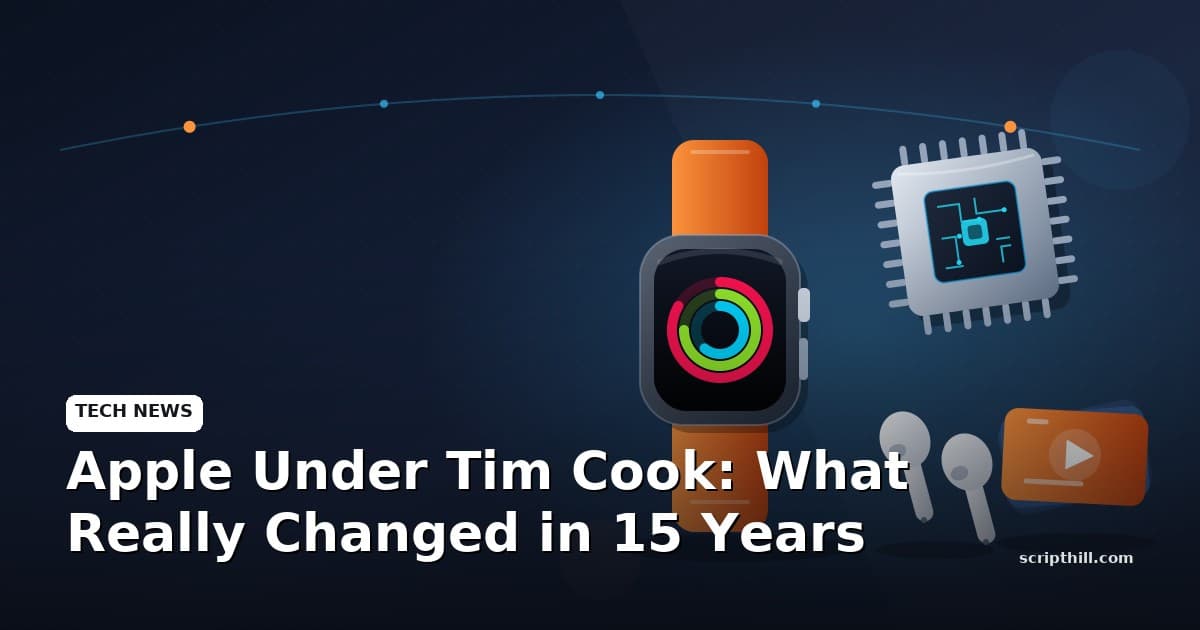
Tim Cook's last day as Apple's CEO was August 31, 2026. He's now executive chairman, and John Ternus, the hardware engineering chief who joined Apple's product design team in 2001, took over on September 1. That ends a run that began in August 2011.
Cook's record is clearer than his critics allow. He didn't create the iPhone, iPad, Mac or App Store, which all launched under Steve Jobs. He built the system around them: Apple Watch, AirPods, Apple Pay and a services business that keeps earning from people who already own the hardware. He also backed the long, expensive chip bet that put Apple silicon in the Mac.
He leaves Ternus two unfinished jobs. Apple is behind in AI, with Siri still lagging, and Vision Pro hasn't found its audience.
Ten launches that defined the Cook era
The iPhone, iPad, Mac, App Store and iTunes all predate Cook, so they show up here only where a Cook-era change transformed them. I've left out the iPhone's USB-C port because regulators forced it. That leaves four genuinely new categories and a longer run of refinements, mostly in services, chips and safety.
| Year | Launch | New or refined | Outcome |
|---|---|---|---|
2014 | Apple Pay | New (payments) | Everyday tap-to-pay habit |
2014–2015 | Beats bought for about $3 billion, then Apple Music | Refined (iTunes went subscription) | Services cornerstone |
2014–2015 | Apple Watch (announced 2014, shipped 2015) | New | Core health device |
2016 | AirPods | New | Big business on its own |
2017 | iPhone X with Face ID | Refined | Set the modern iPhone design |
2019 | Apple TV+ and Apple Card | New services | More ecosystem glue than hits |
2020 | M1 Macs (November, after the Intel transition announcement earlier that year) | Refined Mac, new chips | Biggest technical win |
2021 | App Tracking Transparency in iOS 14.5 | Refined iOS | Hurt ad-driven rivals |
2022 | Emergency SOS via satellite and Crash Detection on iPhone 14 | Refined | Safety as a selling point |
2024 | Vision Pro at $3,499 | New | Struggling at its price |
Services turned owners into recurring revenue
Cook's most consequential change wasn't a device. He got Apple paid, again and again, by people who already owned one. Under Jobs, Apple mostly earned its money once, at the register. Under Cook, the iPhone in your pocket became a storefront that bills you every month.
The pieces stack. Your photos fill up iCloud, so you pay for more storage. Apple Music, rebuilt from the Beats deal, turned iTunes buyers into subscribers. Apple Pay put the phone between you and every card tap, and Apple Card pulled the card itself into the Wallet app. Apple TV+ never became a breakout hit, but it gives the Apple One bundle another reason to exist. None of these has to win its category, because each one makes leaving a little more expensive.
That's what investors pay for. iPhone sales rise and dip with upgrade cycles, while subscriptions keep billing through a slow year. Services carry much higher margins than hardware and grew into one of Apple's largest revenue lines, which pushed Wall Street toward valuing Apple less like a gadget maker and more like a software company. It's the retention logic behind growth loops for SaaS, applied to an enormous installed base.
The lock-in cuts both ways. Your messages, photos, passwords and payments follow you to the next Apple device without effort. Leaving, though, gets expensive, and regulators have noticed. The App Store's commission, Apple's control over the iPhone's tap-to-pay chip and its default-app rules have drawn antitrust action in the US and Europe, and some cases have already forced concessions. Of everything Cook built, the services machine is the part most likely to be reshaped by courts rather than by Ternus.
Apple silicon was the biggest technical bet
The strongest rebuttal to "Cook only optimized" is the chip inside a current Mac. When Apple said in 2020 that it would leave Intel, it staked the entire Mac line on silicon its own team had spent about a decade refining for the iPhone and iPad. The M1 Macs that shipped that November make the move look obvious now. It didn't look obvious during the years the money was going in.
That kind of patience is an operations CEO's strength. Johny Srouji's chip group got steady funding for years with no Mac payoff in sight, and Cook's supply-chain discipline meant Apple could build those chips at volume once the time came.
Owning the chip changes the product in specific ways. Apple designs silicon around the battery, heat limits and features it wants instead of buying whatever Intel sells every PC maker. Better performance per watt means longer battery life and less heat, which is why a fanless MacBook Air can do real work. One shared architecture across iPhone, iPad and Mac lets features and code move between devices. And the margin Intel used to collect now stays with Apple.
The in-house C1 modem, which arrived in early 2025, applies the same logic to a component Apple had always bought from outside. Srouji's promotion to chief hardware officer as part of the handoff shows how central this work has become.
Apple Watch and AirPods were new categories
If you want to know whether Cook's Apple built anything truly new, start with Apple Watch and AirPods. Neither was an inherited product line he simply refined.
The Watch had an awkward start. Apple pitched it in 2015 partly as a fashion item, complete with a gold Edition model, and it took a few years to find its purpose: health and safety. ECG readings, irregular-rhythm (AFib) alerts and fall detection turned it from a notification screen into something people wear because it might flag a heart problem or call for help after a fall. That's a far better reason to buy one than a new band.
AirPods arrived in late 2016 to plenty of jokes about how they looked. Then they became a large business in their own right and made wireless earbuds the default rather than a niche. The selling point was pairing: open the case near an iPhone and they connect with no setup.
Investors should notice the dependence. An Apple Watch needs an iPhone to work, and AirPods lose most of their convenience without one, so each gives owners another reason to buy their next phone from Apple. AirTag (2021) repeats the pattern on a smaller scale. It's an inexpensive tracker that only works as well as it does because the Find My network runs on the Apple devices people already carry.
Privacy became a product feature
Cook turned privacy into something Apple could sell, and then into a weapon against competitors. The defining moment came in 2016, when the FBI wanted Apple to build software to get into the iPhone used by the San Bernardino shooter. Cook refused publicly, arguing that a tool built for one phone would weaken security on every phone. The government eventually got into the device another way and dropped the case, and Apple walked away with a reputation no ad-funded rival could easily copy.
App Tracking Transparency wrote that stance into the operating system. Since iOS 14.5, apps have had to ask before tracking you across other companies' apps and websites, and many people tap no. That weakened the cross-app targeting businesses like Meta depended on, and they complained loudly.
Critics see self-interest alongside the principle. Apple runs its own ad business, including placements in App Store search results, and its first-party targeting isn't covered by the same prompt. A rule that cuts off rivals' tracking data while leaving Apple's intact helps Apple twice: owners got real control over their data, and Apple got an edge it could turn into ad revenue.
The iPhone kept changing underneath
Cook didn't create the iPhone, but the one you carry looks and works the way it does because of decisions made on his watch. The iPhone X in 2017 is the clearest case. It dropped the home button, stretched the screen nearly edge to edge and fit Face ID's depth-sensing camera into a notch at the top. Android makers soon shipped notches of their own, and Apple's lineup followed that template for years.
The iPhone 14 mattered for a different reason. Emergency SOS via satellite lets you text for help where there's no cell signal, and Crash Detection can call emergency services if you don't respond after a severe crash. Neither feature sells phones in a store, but both are built for the moments when a phone matters most.
Inside, more of the phone became Apple's own. The A-series chips started here before they powered the Mac, and the C1 modem replaced one of the last major supplier parts, giving Apple more control over battery life, performance and its supply chain.
The bets that missed
AI is the miss that matters most, because it's still unresolved. Siri gave Apple an early lead in voice assistants, then fell behind for years while rivals rebuilt their assistants around large language models. Apple Intelligence began rolling out in late 2024, but Apple then delayed some of the Siri and Apple Intelligence features it had promised. That gap landed on Ternus's desk on day one, and coverage of his first week framed the job as catching up in AI. Apple usually ships late but finished. Shipping late and incomplete is unfamiliar territory.
Vision Pro is the most expensive bet that hasn't paid off. The headset proves what Apple's display and chip teams can build, but at its launch price it has stayed niche, and Apple hasn't found the everyday use that would make owners of its other devices want one. A cheaper, lighter version may still justify the platform, but that would be Ternus's result, not Cook's.
The car project never launched at all. It reportedly ran for years, pulling in engineers and money, before Apple cancelled it in 2024. It's the clearest case of Cook's Apple committing to a category it couldn't crack, and the cost is hard to measure from outside.
Apple Maps is the miss that turned around. Its 2012 launch went badly enough that Cook publicly apologized, which Apple rarely does. Instead of retreating, Apple kept rebuilding its own mapping data until Maps became a credible default. That slow, in-house fix is the approach Apple now has to repeat with Siri.
What Ternus inherits
Picking a hardware engineer tells you where Apple thinks its next fight is: AI that has to run well on chips and devices Apple designs, not just inside a chat app. Ternus, 51, has spent his career on the product side and ran hardware engineering from 2021, the stretch when Apple silicon spread across the lineup and the C1 modem shipped.
When Apple announced the handoff on April 20, 2026, it reshuffled leadership around him. Besides Srouji's promotion, Arthur Levinson became lead independent director and Ternus joined the board.
His first staff memo hinted at a "huge launch next week." What that launch delivered hasn't been verified, so it's too early to say whether it closed any of the AI gap.
Don't expect a reset. Cook remains executive chairman, and the people running Apple's chips and hardware are the ones who built the M1. The likely result is Cook's Apple with an engineer's priorities, where AI gets judged by what it does on the device in your hand.
Builder, not just optimizer
"Cook only optimized" doesn't hold up. A CEO who staked the Mac on Apple's own chips and launched two categories from nothing wasn't coasting on Jobs's catalog. Still, his signature achievement isn't the chips or the wearables. It's the business model. Cook turned a hit-driven phone maker into a company that gets paid for as long as you own its devices, and most of his big product decisions fed that machine.
The market rewarded it. Apple's value went from roughly $350 billion in 2011 to about $4 trillion by late 2025. That number grades the business more than the products, because investors were paying for predictable revenue as much as for great devices.
The AI work is what Cook left unfinished. If you're weighing your next upgrade or your Apple position, judge Ternus on one thing: whether the delayed Siri features ship and run well on hardware you already own.
Sources
Want more from ScriptHill in Google? Add us as a preferred source