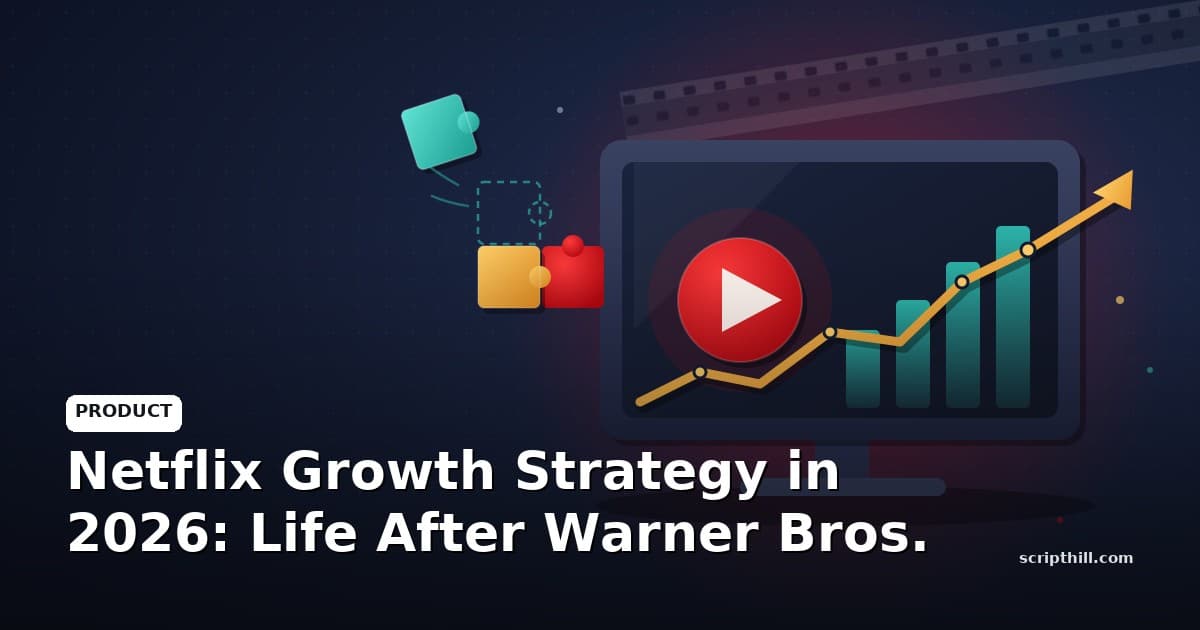
Netflix is still growing, and it's still very profitable. Third-quarter 2026 revenue, reported October 20, rose about 12% to $12.9B at a 34.6% operating margin. The company expects roughly $51.1B for the full year.
The headlines told a different story. Growth slowed from about 17% a year earlier, the ad forecast came down, about 1,000 jobs went, and the stock fell about 6% after an earnings beat. Back in February, Warner Bros. Discovery had already walked away from its Netflix deal to sign with Paramount Skydance.
That loss reshapes the Netflix growth strategy. With no big library left to buy, Netflix has to grow on its own through price increases, ads, selective live events, licensed content and tight cost control.
Still growing, just slower
The quarter itself was strong. Netflix earned $3.66B in net income, or $0.87 a share, beating the $0.82 analysts expected, and operating income rose 37% to $4.46B. That jump flatters the business a little, because Q3 2025 absorbed a $619M Brazil tax charge and left last year's base artificially low. Adjust for it and Netflix is still turning more than a third of its revenue into operating profit.
In 2025, Netflix made $45.2B in revenue, up 16%, at a 29.5% operating margin. Its original 2026 guide was $50.7B to $51.7B at a 31.5% margin, and the current forecast sits near the middle of that range. So revenue growth is cooling toward the low double digits while margins keep widening.
The selloff was about what comes next. Q4 guidance calls for $13.44B in revenue, about 11.5% growth, and EPS of $0.67, short of the roughly $0.73 Wall Street had penciled in. Add the lowered ad forecast and investors got three pieces of bad news on the same day.
None of that describes a business in trouble. A company growing double digits at a mid-30s margin isn't collapsing. What changed is the story the stock was priced on. Market data cited in one post-earnings analysis put shares about 44% below their 52-week high and at roughly 19 times trailing earnings, which is how the market values a mature, cash-rich company. That's now the standard Netflix's strategy has to meet.
Margin is the real target
Every move Netflix made in 2026 runs through one constraint. The company describes its core strategy as growing globally "within the parameters of our operating margin target," in the words of its Q3 10-Q filing. Growth is the goal, and spending has to fit under the margin.
That's why Netflix stopped reporting subscriber counts every quarter in 2025. A business that makes more money through price increases and ads doesn't need a bigger sign-up number to grow, so management steers by revenue, margin and engagement instead.
Think of the margin target as a budget ceiling. When revenue growth slows from the high teens to around 12%, the room for costs grows more slowly too, and something has to give even at record profitability. Hence the roughly 1,000 layoffs and the executive firings: Netflix is cutting to hold the ratio. The Q4 guide absorbs about 120 basis points of headcount-reduction cost, a one-time hit that leaves a lower cost base for the years after.
Content spending follows the same rule. Cash content spend runs at about 1.1 times amortization, so Netflix pays for shows at roughly the pace it expenses them. It's a steady budget, not an arms race.
The cash points the same way. Netflix repurchased a record $4.80B of stock in Q3 rather than chasing growth at any price. Its free cash flow guide slipped to about $12.0B from $12.5B, partly because of a planned Q4 real estate transaction.
Price increases do the heavy lifting
Price increases are Netflix's biggest growth lever right now, and management says they're working. In the Q3 shareholder letter, Netflix said members reacted to the 2026 price changes the way they did to earlier increases. Management reads that as healthy engagement: people still value the service enough to pay more.
The viewing data complicates that reading. Netflix's H1 2026 "What We Watched" report showed total hours up 2% while viewing per user fell. Revenue isn't growing because people watch more. It's growing because more households pay, and each pays more.
That can work for a while, but the math gets harder each time. When prices go up and hours per person go down, your cost per hour watched rises on both counts, and the next increase is tougher to justify to a household going through its monthly bills.
Nobody knows how much headroom is left, Netflix included. Churn depends on household budgets, competing services and what's on the slate that month, so the ceiling only shows itself once someone hits it.
The ad tier is the safety valve. A household that balks at a pricier plan can drop to the cheaper ad-supported one instead of canceling, which keeps it paying and adds to the audience Netflix sells to advertisers.
Why the ad forecast came down
Netflix's ad business is still growing fast, just more slowly than Netflix promised. It now expects about $2.7B in ad revenue for 2026, down from about $3B, and blamed a slower-than-expected rollout of some ad capabilities. It hasn't said which ones.
The January plan was for ad revenue to roughly double from 2025's "over $1.5B," which was itself up more than 2.5x from the year before. Doubling meant about $3B. The new number is still a big one-year jump.
In dollars, the miss is small. The $300M shortfall is about 10% of the ad forecast but well under 1% of total revenue. Ads come to about 5% of the business ($2.7B ÷ $51.1B ≈ 5.3%), and subscriptions carry the rest.
It matters for a different reason. Netflix pointed to its own rollout, not to advertisers pulling back, so this is a technology problem rather than a demand problem. Live events like the NFL game from Melbourne are a big part of the pitch to advertisers, and that pitch is landing. What slipped is the tooling that turns a growing ad-tier audience into revenue, and that build-out has to speed up before ads can become a much larger share of the business.
The Warner Bros. deal that got away
Losing Warner Bros. means Netflix has to rent depth instead of owning it. On Dec 4, 2025, Netflix agreed to buy Warner Bros. Discovery's studios and streaming business, HBO and HBO Max included, at an enterprise value of $82.7B, or $72B in equity. On Jan 19, 2026, it amended the offer to all cash at $27.75 per WBD share. It still wasn't enough.
On Feb 27, WBD terminated the agreement and signed with Paramount Skydance, which paid Netflix a $2.8B termination fee that Netflix booked in Q1. On Sep 21, Paramount settled a state antitrust challenge by accepting a five-year consent decree, and in late September it said it expected to close in about two weeks. Whether or not that close has happened yet, a combined Paramount–Warner Bros. is the rival Netflix now has to plan around.
Netflix gave up a lot: decades of library depth, established franchises it wouldn't have to build from scratch, and HBO Max, which could have become a bundle or a premium tier. Under a margin-first model, what it avoided counts too. There's no acquisition debt and no interest bill eating into operating income, no years of regulatory risk, and it walked away $2.8B richer.
The replacement play is licensing and partnerships. The TF1 deal in France puts another company's channels and content inside Netflix's app, giving it local depth without buying a broadcaster. Rented content can be renegotiated or pulled when a deal ends, but it keeps costs flexible. Netflix also made an all-cash acquisition of about $587M in March 2026; its filing doesn't name the target.
Live events, games and podcasts
Netflix buys moments, not seasons. Its live lineup is a run of one-night events: an NFL game from Melbourne, an Anthony Joshua fight, the World Baseball Classic in Japan, and what the Q3 shareholder letter called a strong slate in India. Notice what's missing. Netflix isn't bidding for full-season league rights, the multiyear commitments that lock in cost whether the audience shows up or not.
One-off events do two jobs a library can't. They create appointment viewing, a reason to open the app at a set time. And they generate premium ad inventory, a large live audience that advertisers pay more to reach, which ties live directly to the ad tier that's running behind plan.
Video podcasts and cloud-first games are further back. Netflix listed both as 2026 build-outs in January and hasn't reported anything showing them moving revenue. They're engagement plays: frequent, lower-cost formats that fill the gaps between big releases, plus games built to stream rather than install.
What connects all of it is daily habit at a controlled price. Each format gives you another reason to open Netflix without tying the company to a league's fixed costs.
The engagement problem and YouTube
Engagement decides whether the price increases keep working, and the per-user decline is the weak spot. Six months earlier the picture looked healthier: in its Q4 2025 shareholder letter, Netflix said H2 2025 viewing hours rose 2%, with branded originals up 9%.
Scale cushions the slide. Netflix finished 2025 with more than 325M paid memberships and now describes its audience as "approaching one billion people." Few rivals can put a show in front of that many people.
YouTube is where falling per-user hours hurt most. It competes for the same living-room TV, but its video is free, made by creators Netflix would have to pay, and funded by ads. Netflix pays for nearly every hour it serves and then asks you to pay as well. When each member watches a little less, the case for the next price increase weakens exactly where YouTube's case is strongest.
The studios come from a different direction. A combined Paramount–Warner Bros. holds a deep library of established franchises plus HBO, making it a bigger rival in owned IP than either company was alone. Disney pairs its own franchises with sports.
Netflix has neither a century-old catalog nor league rights. It answers with originals, licensed content from partners like TF1, and selective live events. That mix is cheaper to run inside a margin target, but it means Netflix has to keep winning attention one release at a time, without owned franchises that bring viewers back on their own.
Frequently Asked Questions
When will Netflix report Q4 2026 earnings?
Expect Netflix's Q4 and full-year 2026 results in mid-to-late January 2027. That's when it has reported fourth-quarter numbers in recent years, and the exact date usually appears on its investor relations site a few weeks ahead. The report will show whether the Q4 guidance held, where full-year ad revenue landed, and what Netflix plans for 2027 in revenue and margin.
How many subscribers does Netflix have in 2026?
The most recent official figure, covering year-end 2025, put paid memberships above 325 million. Since Netflix stopped quarterly subscriber reporting, there's no newer company number, so be skeptical of sites quoting fresh totals; some contradict Netflix's own figures. The "approaching one billion" figure counts people, not accounts, because one membership usually covers several viewers in a household.
Is Netflix's strategy still working?
Yes, as a profit engine. Netflix is growing double digits at roughly a 35% margin, carries no acquisition debt, and got paid for the deal it didn't get. Few media companies can claim any of that.
What's changed is the foundation. Netflix now grows by charging more and selling ads, not by getting people to watch more. Pricing power ultimately borrows against engagement, and a self-reinforcing engagement-driven growth loop is what Netflix lacks right now.
Two signals in the January report will settle it: whether viewing per user stabilizes, and whether ads land near the revised $2.7B. If both hold, the margin-first bet is paying off. If per-user viewing drops again and ads miss a second time, the next price increase becomes Netflix's biggest risk, and any thesis built on its pricing power deserves a second look.
Sources
Want more from ScriptHill in Google? Add us as a preferred source