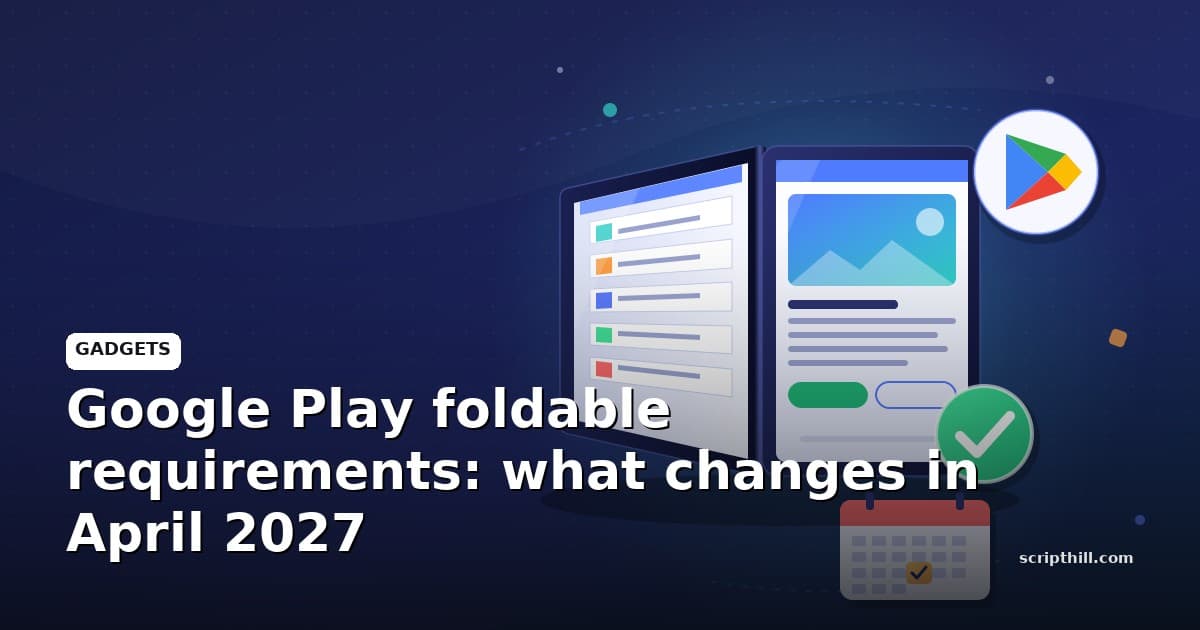
Starting in April 2027, Google Play will accept new apps and updates only if they meet Google's Tier 3 "Adaptive ready" quality bar for foldables and their store listings include three foldable screenshots. Games need the screenshots on the same schedule but have until August 2027 to meet the quality bar. Google announced the policy on November 18, 2026, and foldable screenshot uploads opened the same day.
Headlines about Google "blocking" apps overstate what's happening. The Google Play foldable requirements control what can be published, not what's already installed or listed. The pressure falls on apps that keep shipping updates.
What the Google Play foldable requirements actually block
Nothing on an owner's foldable gets uninstalled or switched off. An app that misses the bar can't publish a new release or update on Play, according to Android Authority, and FoneArena reports that apps already listed stay downloadable if their developers never touch them again. That cuts both ways. An abandoned app stays exactly as it is today, black bars on the inner screen included, and it keeps losing the half-written message when the phone unfolds.
The real risk is with actively maintained apps that people rely on. If a popular messaging, banking or note-taking app isn't foldable-ready by its deadline, its developer has to fix the layout before the next update ships, and a new feature or security fix waits until then. Small teams with portrait-locked apps are the most likely to get caught.
What Tier 3 asks of an app
Tier 3 is the only level Play will enforce, and it targets the failures foldable owners run into most. According to Android Authority's breakdown of the guidelines and TalkAndroid, Google's adaptive app quality guidelines stack three tiers, with Tier 1 the most demanding:
| Tier | Name or level | What it requires | Required by Play? |
|---|---|---|---|
Tier 3 | Adaptive ready (baseline) | Fills the available display with no letterboxing or compatibility modes. Keeps scroll position, text input and media playback through rotating, folding, unfolding and resizing. Works in multi-window mode. | Yes |
Tier 2 | Middle level | Multi-pane layouts, plus basic external keyboard, mouse and stylus support | No |
Tier 1 | Top level | Tabletop and book postures, camera continuity, interactive picture-in-picture | No |
Tier 3 is a floor. A compliant app has to stop failing in those basic ways, but it doesn't have to do anything clever with the extra space. A news app can pass by stretching its single column across the inner screen. A side-by-side list-and-article view is a Tier 2 feature, which Play doesn't require.
What changes on your foldable
The first change shows up in the Play Store, not on the phone. Foldable screenshots should start appearing in listings over the next few weeks, so buyers can see how an app looks on both the inner and cover screens before installing it.
The apps themselves improve more slowly, one update at a time after April 2027, and owners don't need to do anything. Over time, fewer apps should sit between black bars or stay stuck in portrait. Fewer should discard a draft or restart a video when the phone opens, which is the most common everyday annoyance on foldables.
Owners shouldn't expect every app to start using the big screen well. Many will simply stop looking broken.
Deadlines for apps and games
Games are the only category on a split schedule. Every other app faces both requirements at once.
- November 18, 2026: Google announced the policy, and developers can upload foldable screenshots now.
- April 2027: New apps and updates need Tier 3 and the three foldable screenshots. Games need only the screenshots.
- August 2027: Games must meet Tier 3. Google's Mishaal Rahman confirmed the later date, according to Android Authority's report on the guidelines and Digital Trends.
- Later phases: The requirements will extend to tablets, Googlebooks and Android XR devices. Google hasn't announced dates.
Google hasn't named the exact day in April or August. It also hasn't said whether it will check Tier 3 through automated testing or manual review, so how strict enforcement will be is still unknown.
What developers must submit
Each listing needs at least three foldable screenshots in addition to the standard two phone screenshots. According to Google's Android Developers Blog post on the new standards, the foldable set must include at least one 1:1 inner-screen shot, one 4:3 inner-screen shot and one outer, or cover, screen shot. TalkAndroid reports that games submit the three foldable shots plus one phone screenshot in their main orientation. Phone listings may also include an optional 16:9 horizontal shot next to the 9:16 portrait ones. All of these go into Play Console under Grow > Store presence > Store listings.
Captures from Google's foldable emulators count, so a small team doesn't have to buy a Fold. The engineering work remains, and it usually means:
- Folding, unfolding, rotating and resizing the app in the emulator, and checking that scroll position, text input and media playback survive each change.
- Removing orientation locks and fixed aspect ratios so the app fills the inner screen without letterboxing.
- Running the app in multi-window next to another app.
- Capturing screenshots only after those fixes, because the inner-screen shots will show any leftover black bars to shoppers.
Portrait-locked apps and games built around a fixed aspect ratio carry the heaviest burden, which is presumably why games get four extra months.
Why Google is pushing this now
The Play policy finishes a shift Android itself started. For apps targeting its API level, Android 16 already ignores app-declared orientation and aspect-ratio locks on large screens, with a temporary opt-out, and Play's yearly target-API deadline usually lands in August. The store rule pushes in the same direction from the distribution side and covers every new release, whatever API level it targets. Google wants Android's lead in foldable hardware backed by apps that actually work on it before the requirements expand to other device types.
Android Headlines ties the timing to Apple, saying Apple's iPhone Duo foldable launched weeks earlier with more than 200,000 optimized apps. The outlet also expects Android 17 / API 37 requirements in August 2027, the same month games face their Tier 3 deadline.
Sources
- Elevating apps: New adaptive quality standards on Google Play | Android Developers' Blog · developer.android.com
- Google’s mandatory foldable app guidelines are here, and optimized apps are coming in 2027 · androidauthority.com
- Google Forces Apps to Support Foldables by 2027 · androidheadlines.com
- Google Play Foldable App Requirements Start April 2027 · talkandroid.com
Want more from ScriptHill in Google? Add us as a preferred source