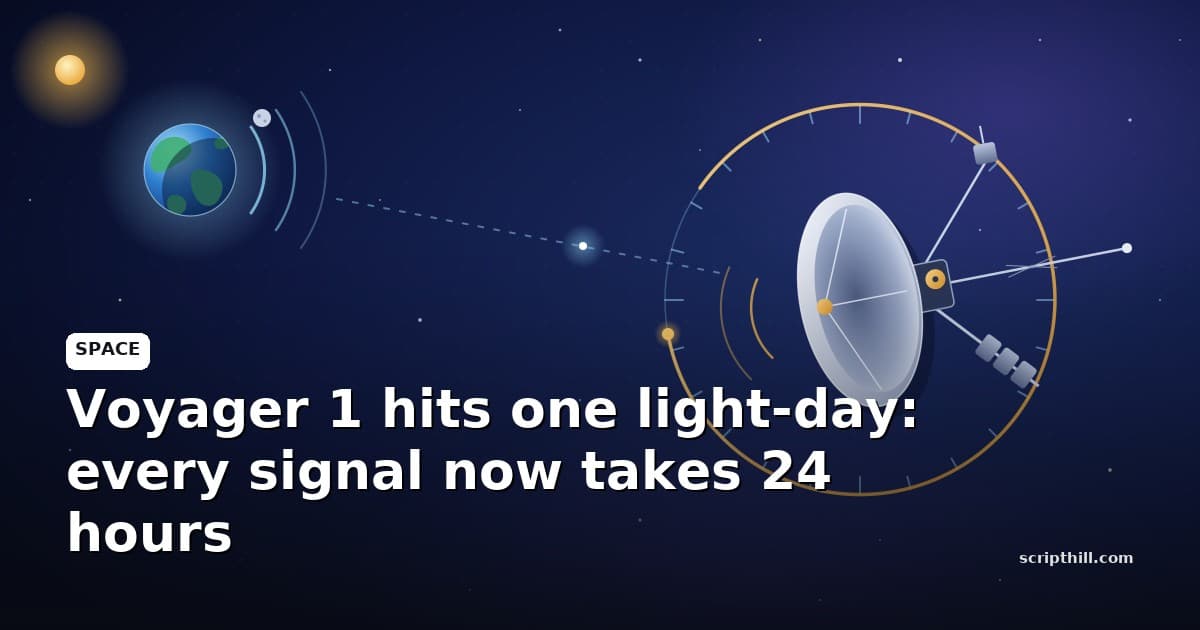
At 10:16 UTC on Nov. 18, 2026, just after 5:16 a.m. ET, NASA's Voyager 1 became the first human-made object to reach one light-day from Earth. That's about 16.1 billion miles (25.9 billion km), or roughly 173 AU.
The milestone has a practical cost. Every radio command sent from Earth spends a whole day in transit before Voyager 1 receives it, and the response needs one more day to return, so each exchange with the 49-year-old probe stretches to 48 hours. Voyager 1 has been the most distant human-made object since it passed Pioneer 10 in 1998.
"It's never happened before, and it may never happen again," mission manager Kareem Badaruddin told CNN.
What a light-day actually measures
A light-day is how far light travels in one day. "One light-day is not a time so much as a distance," project scientist Linda Spilker told ABC. NASA uses round figures: light moves about 186,000 miles (299,000 km) per second, which comes to roughly 16.09 billion miles (25.89 billion km) in 24 hours. JPL noted that crossing the line changed nothing about the spacecraft or the space around it. The milestone exists only because people picked the unit.
Because Voyager 1 coasts without propulsion, engineers know its path precisely enough to time the crossing to the second. EarthSky put the moment at 10:16:07 UTC. Distance from the Sun is a separate milestone, and Voyager 1 reaches one light-day from the Sun on Feb. 4, 2027. The Earth figure is less tidy. Over a year, the planet swings up to about 1 AU closer to the probe or farther from it, so the Earth–Voyager distance may briefly dip back near one light-day before the probe's outward travel carries it clear.
A two-day conversation with Earth
That round trip rules out fixing problems by quick trial and error. Each step on the aging hardware has to be planned, checked and sequenced before anything is sent. If a command goes wrong, the spacecraft stays in that state for at least a day before anyone on Earth can see it, and the correction takes another day to arrive. Meanwhile, the probe keeps moving away at about 61,000 km/h (roughly 38,000 mph).
By the time the reply gets home, it's barely there. NASA's Deep Space Network picks it up with large dish antennas in Canberra, California and Madrid. The received signal is about −160 dBm, or roughly 100 attowatts. An attowatt is a billionth of a billionth of a watt, so the transmission reaching a dish amounts to about one ten-quadrillionth of a watt.
Two instruments and a shrinking power budget
Voyager 1 still returns science data, but only from two of its ten instruments: one measures plasma waves, the other magnetic fields. That count dates from April 17, 2026, when engineers switched off the Low-energy Charged Particles experiment (LECP).
The decision followed a scare. On Feb. 27, the spacecraft's power dropped unexpectedly. A further drop could have tripped its undervoltage fault protection, forcing a slow, risky recovery across the communication delay. NASA shut LECP down to keep the spacecraft operating, building a power margin before a fault rather than recovering after one. The order in which instruments go dark was agreed years ago, and seven of each Voyager's ten instruments are now off.
The probe runs on nuclear power sources called radioisotope thermoelectric generators (RTGs), whose output falls by about 4 watts a year. By April 2026 it was below half its original level. Some of what remains has to keep the fuel lines from freezing, so not every watt can go to science.
NASA's next step is a plan it calls the "Big Bang," which switches off a group of devices at once and replaces them with lower-power alternatives. The agency hasn't set an end date, but the mission is in its final stretch.
Still nowhere near another star
JPL's Jason Rhodes put the distance in perspective, according to PBS: the Sun is about eight light-minutes from Earth, and Voyager 1 is now about 1,440 light-minutes away. Proxima Centauri, the nearest star, is about 4.2 light-years out, or roughly 1,500 light-days. Nearly 50 years of travel has covered about 1/1,500 of that distance, and at Voyager 1's speed the full trip would take tens of thousands of years. The probe isn't aimed at Proxima anyway. It's heading generally toward Gliese 445, about 17 light-years away, and in about 40,000 years it will pass within about 1.7 light-years of that star.
Voyager 1 is in interstellar space, beyond the heliosphere. The Oort Cloud lies farther out, though, so the probe has "left the solar system" only in that narrower sense. Five spacecraft are on paths out of the solar system. Voyager 2 reaches one light-day from Earth on Nov. 1, 2035, though it's unclear whether either Voyager will still be communicating by then.
NASA marked the crossing with a worldwide "Shine Bright" celebration and an illustration by space artist Don Davis, and it has posted Voyager posters and postcards to download. Voyager 1 turns 50 in 2027. Its most lasting picture came in 1990, when Carl Sagan urged the team to turn the cameras toward home. Minutes before they were shut off for good, Voyager 1 photographed Earth as a pale blue dot.
Sources
- Voyager 1 reaches 1 light-day from Earth! · earthsky.org
- Voyager 1 reaches a milestone nearly 50 years in the making: One light-day from Earth :: WRAL.com · wral.com
- Voyager 1 is now a light-day from Earth. Here’s what to know about NASA’s longest-running mission · pbs.org
- NASA Shuts Off Instrument on Voyager 1 to Keep Spacecraft Operating - NASA Science · science.nasa.gov
Want more from ScriptHill in Google? Add us as a preferred source