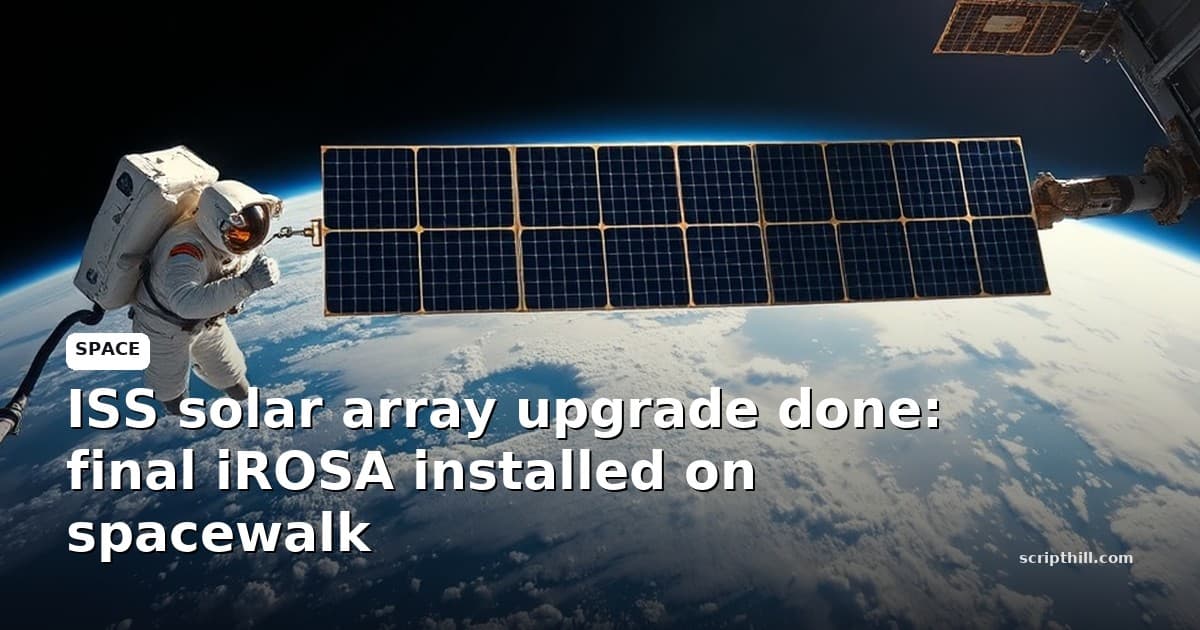
On Thursday, Nov. 5, 2026, NASA astronaut Anil Menon and Canadian Space Agency astronaut Joshua Kutryk spent about seven hours outside the International Space Station installing and deploying the eighth and final ISS Roll-Out Solar Array, or iROSA. No problems were reported.
The spacewalk completed the solar array upgrade NASA began in June 2021. Over 18 spacewalks, the new arrays have raised the station's generating capacity from 160 kilowatts to about 215 kilowatts, according to NASA. The station is due to retire around 2030, and the added power is meant to keep it running at full capacity until then.
How the final spacewalk went
The spacewalk was scheduled to begin at 8:30 a.m. EST. Menon and Kutryk, both Expedition 75 flight engineers, had one main job: mount the last iROSA on its bracket, then deploy it. The station's robotic arm moved hardware into position and carried the crew to their work sites.
It was the pair's second trip outside in a week. On Oct. 29 they installed the seventh iROSA during the 100th U.S. spacewalk from the ISS. The Nov. 5 outing was the 101st, and the ninth spacewalk of 2026.
The two outings also mattered for Canada. Kutryk's spacewalks are the first by a Canadian astronaut since 2019. Canada's main contribution to the station has been robotics, centered on Canadarm2, the station's main robotic arm, so these spacewalks put a Canadian astronaut outside while the Canadian-built arm handled the hardware.
Menon marked the end of a design effort that stretched back more than 15 years as the work wrapped up:
"Today marks the completion of not just one solar array but, over 15 years after its development, eight arrays."
Anil Menon, NASA astronaut, as reported by Space.com
What makes iROSA different
The new arrays didn't replace the station's original solar wings. They were added on top of them.
The legacy wings are made of rigid panels that were folded for launch and extended once in orbit. An iROSA is a flexible blanket of solar cells that rolls up like a tape measure. Once released, it unrolls on its own, pushed outward by energy stored in its composite booms as they straighten. Redwire builds the arrays, which are based on roll-out technology first tested on the ISS in 2017.
Each iROSA sits on a bracket fixed over one of the legacy wings, tilted away from it at an angle. The new array partly shades the old one, but the older wing keeps generating power underneath, and the pair produce more electricity than either could alone.
Keeping the old wings also spared spacewalkers a much harder job. Removing and disposing of large rigid wings would have been far more complex and risky than attaching a compact roll to a bracket and letting it unfurl.
Why a retiring station needed more power
The original solar wings were wearing out. The first went up in 2000, and they were designed for about 15 years of service. Well past that design life, their output has steadily declined.
Demand rose over the same period, as science experiments, life support and other onboard equipment drew more electricity. Relying only on the aging wings would have meant a shrinking power budget against growing needs, forcing planners to choose which experiments to run and which to shelve.
The iROSAs closed that gap. The margin took more than five years to build, and most of it goes to a station that will still be doing science for several more years, not one being kept on life support.
After the final deployment, mission control's Stilwell congratulated the crew on upgrades that "will take it to the end of its journey," a reference to the station's planned retirement.
Where roll-out arrays go next
The roll-out design that now powers the ISS isn't a one-off. The same technology flew on NASA's DART asteroid mission, and it's planned for future spacecraft, including the commercial stations meant to follow the ISS.
The installation also became an argument for people in orbit. Space Foundation argues that astronauts still beat robots at complex installation work like this. On this outing, the robotic arm played a supporting role.
NASA hadn't detailed its next spacewalks in its coverage of this one. Replays of the Nov. 5 outing are on NASA+ and NASA's YouTube channel.
The arrays' longer contribution comes after the spacewalks. Each year they keep working on the ISS adds to a long-duration test of the design that ground testing can't fully reproduce, and those results will inform the commercial stations that plan to use the same hardware.
Sources
- NASA spacewalk: Astronauts will finish solar array upgrades at ISS · fox35orlando.com
- "We got it done!' Spacewalking astronauts finish installing next-gen ISS solar arrays · space.com
- Astronauts Complete ISS Solar Array on 101st Spacewalk · spacefoundation.org
Want more from ScriptHill in Google? Add us as a preferred source