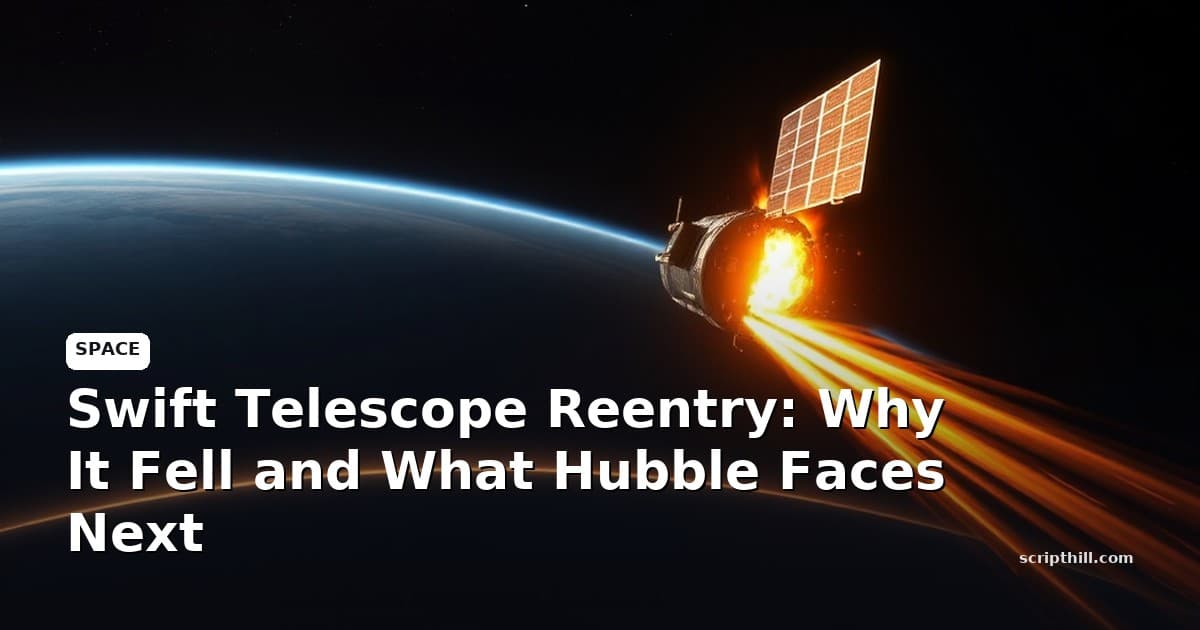
NASA's Neil Gehrels Swift Observatory reentered Earth's atmosphere at 7:39 a.m. EST (12:39 UTC) on Wednesday, Nov. 4, 2026, over North Sumatra, Indonesia, the U.S. Space Force confirmed. The roughly 3,200-pound spacecraft broke apart and mostly burned up high in the atmosphere. No injuries had been reported as of Nov. 5, 2026.
Headlines saying the telescope "crashed" get the physics wrong. Nothing hit the ground in one piece. The Swift telescope reentry was a breakup at altitude, and observers in Malaysia reported seeing it. A few dense parts, such as titanium structures, may have survived and fallen along the flight path.
That leaves four questions: why a 22-year-old observatory with no engine fell when it did, what happened to the commercial rescue that never reached it, what Swift's science leaves behind, and whether Hubble faces the same fate.
When and where Swift came down
The Space Force put the reentry at 7:39 a.m. EST (12:39 UTC) on Wednesday, Nov. 4, 2026, over North Sumatra, Indonesia, at about 3.4°N, 98.6°E. The spacecraft weighed about 3,200 lb, or roughly 1.5 tonnes, and ABC described it as about the size of a minibus.
NASA's forecast had centered on around 3:30 a.m. ET, plus or minus 11 hours. Swift came down about four hours later. That was comfortably inside the window, but it was enough to move the reentry to a different part of the planet from the one the center estimate pointed to.
The orbit's tilt set the only firm geographic limit. Swift could reenter anywhere between 20.6°N and 20.6°S, a band covering most of the tropics. Colombia's Aerospace Force tracked the descent for that reason, even though the spacecraft ended up on the other side of the world.
Clips shared from Malaysia show a bright streak splitting into fragments. They captured the breakup in the upper atmosphere, not an impact on the ground.
Did any debris reach the ground?
NASA expected most of Swift to burn up, with some components possibly reaching the surface. How much actually survived wasn't immediately known, and the agency hadn't released a final assessment as of Nov. 5, 2026.
Density decides what makes it down. Titanium structures handle reentry heating far better than thin panels or electronics, which made them the likeliest survivors, according to Leonard David's account of the reentry. Fragments don't land at one spot. They scatter along a long, narrow strip under the final flight path, with heavier pieces usually traveling farther than lighter ones.
No injuries or confirmed debris finds had been reported as of Nov. 5.
NASA called the risk to people low. The Times of India reported a more specific NASA estimate: a 1-in-2,100 chance that debris would harm someone. That number hasn't been independently confirmed.
If accurate, it's a high figure. NASA's guideline for new missions requires a casualty risk below 1 in 10,000, which would put Swift nearly five times over the limit. But Swift was designed before the guideline applied to missions like it, and without an engine it couldn't steer toward empty ocean. The estimate also covers everyone along the entire ground track, so any one person's odds of being hit were far smaller.
Why Swift fell, and why NASA couldn't just boost it
In low Earth orbit, a thin trace of atmosphere still drags on anything passing through, and how much depends on the Sun. As Solar Cycle 25 climbed toward its maximum, intense solar activity heated the upper atmosphere and made it swell outward, raising the air density at Swift's altitude. More drag meant faster loss of altitude, and every drop pushed the spacecraft into thicker air, as CBC reported on the telescope's decline.
A satellite with thrusters can fire them to climb back up or aim its final descent at open ocean. Swift had neither option. It launched in 2004 without onboard propulsion, a common choice for low-cost Explorer-class missions then. An engine means the thruster plus fuel, tanks and plumbing. Skipping all of it saved money and mass on a mission meant to last only two years.
The trade-off held for most of two decades. Once the Sun turned active, NASA was left with a working observatory and no way to keep it up.
The decline wasn't sudden. Orbital decay like this is slow and well modeled, and engineers watched Swift sink for months. What remained uncertain was whether outside help could get there first.
The rescue that never reached Swift
NASA looked to industry. It contracted Katalyst Space to send a servicing spacecraft to Swift, attach to it and push the telescope into a higher orbit, adding years to its working life. The Times of India described it as a $30 million mission.
Katalyst's three-armed robot, called Link, ran into trouble shortly after launch and, according to CBS News reporting on the attempt, never got within seven miles of the telescope. The rescue failed in August 2026, less than three months before Swift came down. With no way to raise its own orbit, Swift was then certain to reenter.
It's tempting to conclude that robotic servicing doesn't work. That's the wrong lesson. Katalyst was attempting a fast, low-cost capture of a spacecraft never built to be grabbed, with no hardware on it for a robot to hold and very little time before the orbit decayed. A tight schedule and a non-cooperative target together make one of the hardest jobs in orbital servicing. What failed was a rushed attempt on that kind of spacecraft, not the technology itself.
Swift's final months at a glance
- November 2004: Swift launches on a planned two-year mission. It ends up operating about 11 times longer than that.
- August 2026: Katalyst Space's rescue attempt fails before its robot reaches the telescope. Swift has no propulsion of its own, so reentry is now unavoidable.
- Late 2026: Swift enters safe mode, and the team commands an end to science operations.
- Oct. 23, 2026: NASA formally ends Swift's operations.
- Nov. 2, 2026: The U.S. Space Force issues a reentry forecast.
- Nov. 4, 2026, around 3:30 a.m. ET: This is NASA's center estimate for reentry. The forecast window runs plus or minus 11 hours, which covers a large share of Earth's surface between 20.6°N and 20.6°S.
- Nov. 4, 2026, 7:39 a.m. EST (12:39 UTC): The Space Force confirms reentry over North Sumatra, Indonesia, at about 3.4°N, 98.6°E. That is roughly four hours after NASA's center estimate and well inside the predicted window.
What Swift discovered in 22 years
Swift was built for a two-year mission after its November 2004 launch but ran about 11 times longer, logging over 2,000 gamma-ray bursts as well as 1,400 stellar explosions. Gamma-ray bursts rank among the most energetic explosions known and are usually tied to collapsing massive stars or merging neutron stars. Many fade within minutes to hours, so catching them requires a telescope that spots the flash and swings toward it before the afterglow is gone.
That speed made Swift the field's first responder. It caught new events, fixed their positions and sent out alerts, giving larger observatories such as Hubble and Webb targets they'd never have found alone. The record survives the spacecraft. The main ground station was the Italian Space Agency's Broglio Space Center in Malindi, Kenya, and the data archives sit at NASA Goddard and the University of Leicester, where researchers can still use 22 years of observations. The loss is the fast trigger that many follow-up programs relied on.
Swift carried three instruments that worked as a relay:
- BAT (Burst Alert Telescope): watched a wide patch of sky for gamma-ray flashes and gave a rough location within seconds.
- XRT (X-ray Telescope): pointed at that spot and measured a much more precise position from the X-ray afterglow.
- UVOT (Ultraviolet/Optical Telescope): tracked the fading afterglow in ultraviolet and visible light.
Who catches gamma-ray bursts now
Swift ran that entire relay on one spacecraft, fast enough to hand other observatories a sharp position while the afterglow was still bright. The missions still flying each cover part of it.
| Mission | Main wavelengths | Primary role | Overlap with Swift's job |
|---|---|---|---|
Swift (retired) | Gamma ray, X-ray, ultraviolet/optical | Detect bursts, pin them down, track afterglows | The full relay, from first trigger to precise position |
Fermi (NASA) | Gamma ray | Survey the high-energy sky and monitor for bursts | Detects many bursts, but its burst positions are usually far coarser, and it has no X-ray or UV telescope for follow-up |
SVOM (China–France) | Gamma ray, X-ray, visible | Purpose-built burst detection and follow-up | Closest match in design, pairing a wide-field trigger with narrower X-ray and optical instruments |
Einstein Probe (China) | Mainly soft X-ray | Wide-field search for X-ray transients | Catches X-ray flashes, including some tied to bursts, but lacks a gamma-ray trigger and UV coverage |
As of November 2026, bursts are still being detected, since Fermi and SVOM catch them. What's missing is rapid, multi-wavelength follow-up. Astronomers routinely asked Swift, as a responsive general-purpose X-ray and UV instrument, to point at supernovae, flaring stars and other sudden events. SVOM and Einstein Probe can pick up some of that work, though neither offers Swift's full combination on one spacecraft.
Is Hubble next?
Hubble has both of the problems that doomed Swift: no engine, and an orbit worn down by drag from a solar-swollen upper atmosphere. On most other counts, Hubble is better placed.
| Propulsion | Relative size and survivability | Servicing fixtures | Lead time | NASA's options | |
|---|---|---|---|---|---|
Swift | None | About 3,200 lb; mostly expected to burn up, though dense parts such as titanium structures likely survived | None; never built to be grabbed | Rescue failed in August 2026, less than three months before reentry | One commercial boost attempt by Katalyst Space, then uncontrolled reentry |
Hubble | None | Much larger, so far more of it would survive an uncontrolled reentry | Grapple fixtures left from shuttle servicing missions | More time to study options, according to NASA science chief Nicky Fox | NASA has asked companies whether they could boost, upgrade or deorbit Hubble, or do all three |
Those differences improve the odds for a Hubble rescue without guaranteeing one. Grapple fixtures give a robotic servicer a known, flight-proven place to latch on, which removes the problem that stopped Link: approaching a spacecraft with nothing designed for capture. More lead time leaves room for testing and a backup plan rather than a single rushed try. The stakes are also higher. So much of Hubble would survive reentry that a guided, controlled deorbit is a fallback NASA can't skip if a boost proves too difficult. As of November 2026, NASA hasn't announced its choice.
Four ways a space mission can end
| End-of-life option | Needs propulsion? | Casualty risk | Cost | Science life gained |
|---|---|---|---|---|
Controlled deorbit | Yes, onboard | Lowest; debris is aimed at remote ocean | Fuel and mass budgeted at design | None; mission ends on schedule |
Uncontrolled reentry (Swift) | No | Highest; landing spot unknown until the final hours | No added cost | None |
Commercial boost or servicing | Supplied by the servicer | Low if it works; Swift's attempt never got within seven miles | Contract plus launch | Potentially years |
Graveyard orbit | Yes, onboard | Near zero; avoids reentry entirely | Fuel held in reserve | None; adds to long-term orbital clutter |
Leaving out propulsion saved money in the early 2000s, but once drag took hold it narrowed NASA's choices to an untested rescue or an uncontrolled fall. A spacecraft that can steer its own descent clears NASA's 1 in 10,000 casualty-risk cap for new missions with room to spare. Swift couldn't steer at all.
What to do if you find a suspected piece
- Check whether the find is plausible. Any surviving pieces most likely fell along a long strip under Swift's flight path over North Sumatra. Observers in Malaysia reported seeing it come in, but most of those streaks were the breakup high overhead, not debris landing nearby.
- Leave the object exactly where it is, and don't touch it, even with gloves.
- Photograph it from a few meters away and record its GPS location. On a phone with location tagging turned on, the coordinates should appear in the photo's details.
- Report it. In Indonesia, contact local police or the national space agency, BRIN (formerly LAPAN). In Malaysia, contact local police.
- Keep people away, especially children, until officials arrive. This step is complete once authorities take charge of the site.
Frequently Asked Questions
How can I track future satellite reentries?
Space-Track.org, which publishes U.S. Space Force tracking data, and the Aerospace Corporation's reentry prediction pages both post forecasts for objects expected to come down soon. Early estimates usually span many hours and tighten only in the final orbits. A firm location often isn't known until after the reentry.
Who is responsible if space debris damages property?
The country that launched the object. Under the 1972 Liability Convention, a launching state is absolutely liable for damage its space objects cause on Earth's surface, so victims don't have to prove negligence. Claims run between governments, not through private lawsuits. Canada used the treaty to seek compensation from the Soviet Union after the Cosmos 954 satellite scattered radioactive debris across its territory in 1978.
Why was Swift renamed the Neil Gehrels Swift Observatory?
NASA renamed it in 2018 for Neil Gehrels, the NASA Goddard astrophysicist who led the mission as principal investigator and died in 2017. He shaped Swift from early design through more than a decade of operations. Most news coverage and many scientists still just call it Swift.
Will Swift's data still be available to scientists after the reentry?
Yes. The reentry ended new observations, not the records. Swift's data was downlinked and archived throughout the mission, with copies at NASA Goddard's high-energy astrophysics archive and at the University of Leicester in the U.K. Researchers can keep downloading and reanalyzing two decades of burst, X-ray and ultraviolet observations, and archival work often yields results years after a mission ends.
What Swift's ending should change
The decision to fly without an engine, made before Swift's 2004 launch, set up everything that followed. A spacecraft able to steer into a controlled reentry doesn't leave its last descent to solar weather and an 11-hour forecast window.
The Katalyst attempt adds a second lesson. Grabbing a spacecraft never built to be grabbed, on a rushed schedule, was always a long shot, and the failure says as much about the target as about robotic servicing.
Hubble comes next. Its grapple fixtures and longer lead time only matter if NASA commits to an approach well before reentry becomes unavoidable.
Several questions remained open as of November 2026. No one had confirmed whether fragments will turn up in North Sumatra or Malaysia, and NASA hadn't said how much of Swift survived. The reported $30 million price and 1-in-2,100 risk figure still need checking against NASA's own releases.
For 22 years, Swift flagged gamma-ray bursts fast enough for other telescopes to catch their afterglows. Its archives at NASA Goddard and the University of Leicester remain open to anyone who wants to work with that record.
Sources
- NASA's Swift space telescope plunges to Earth after 22 years in orbit · cbc.ca
- 3,200-pound space telescope plunges back to Earth after 22 years in orbit - CBS News · cbsnews.com
- NASA telescope's 22-year 'big bang' mission comes to fiery end - ABC News · abc.net.au
- NASA’s Swift Observatory Reenters over Indonesia: Fall is in the Air · leonarddavid.com
Want more from ScriptHill in Google? Add us as a preferred source