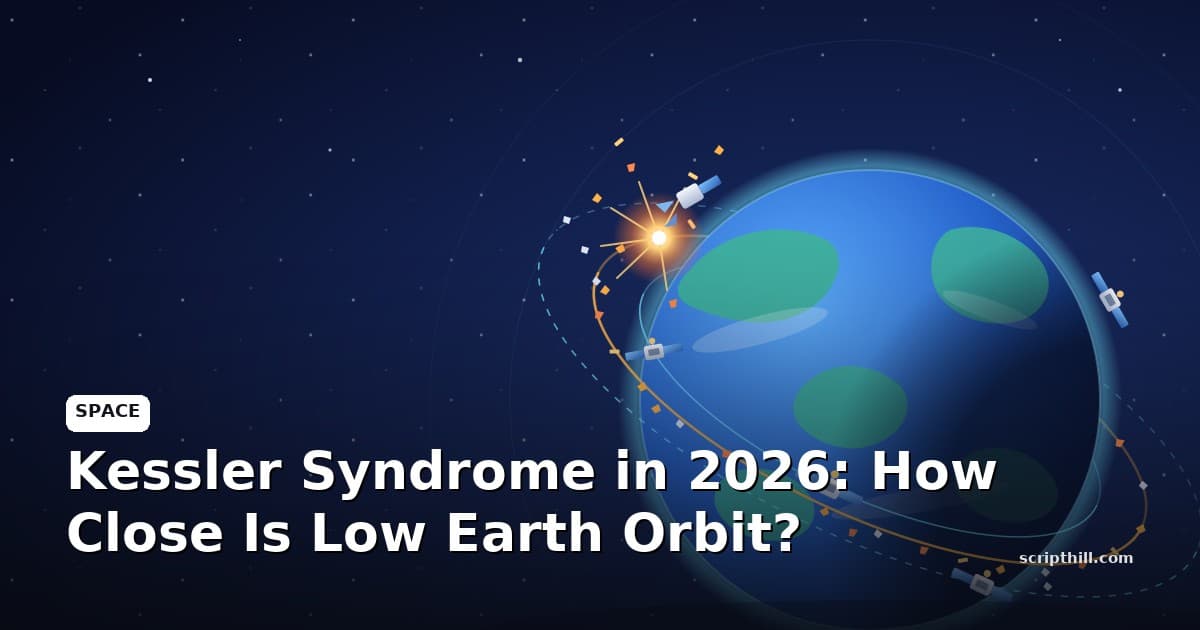
Low Earth orbit isn't about to become unusable. It is closer to Kessler syndrome than it was a decade ago, though. Its safety now depends on thousands of automated avoidance maneuvers going right every day, and some altitude bands already look unstable over the long term.
The biggest shift came in September 2026, when ESA's Space Environment Report concluded that keeping new debris out of orbit is no longer enough. The old debris already up there has to be actively removed.
You've probably seen the headlines: a collision in 2.8 days, risk up 10x. Those numbers come from real research. They just don't measure what most headlines say they do.
What Kessler syndrome actually is
Kessler syndrome is a runaway chain of collisions. Debris from one crash hits other objects, those crashes make more debris, and the cycle feeds itself faster than atmospheric drag can pull the fragments down. Kessler and Cour-Palais described the idea in a 1978 paper, long before anyone launched satellites by the thousand.
Runaway is the word that matters. An altitude band crosses the line when collisions generate debris faster than drag removes it, even if nobody launches another satellite there. After that, the debris population grows on its own.
It's also slow. In the models, a cascade moves band by band over decades, with collision rates creeping upward. The all-of-LEO-shattered-in-an-afternoon version comes from film. A real cascade would look more like a neighborhood getting steadily more expensive and dangerous until operators abandon certain altitudes.
So has it started? Researchers genuinely disagree on whether the cascade is already underway. One camp points to China's 2007 Fengyun-1C anti-satellite test, which filled a heavily used band with fragments, and the 2009 collision between Iridium 33 and the defunct Cosmos 2251. Russia's 2021 Cosmos 1408 anti-satellite test added another large debris cloud. Others, including NASA's Matney, say the runaway hasn't begun. Both sides agree on the events. They differ on where to draw the starting line for a process this slow.
How crowded low Earth orbit is now
LEO has never held more working hardware, and the junk around it outnumbers that hardware several times over.
- About 15,900 to 17,000 working satellites, according to ESA's 2026 Space Environment Report. Launches and retirements shift that figure every week, so any single number is a snapshot.
- About 68,450 objects larger than 10 cm, estimated by ESA's MASTER model for its February 2026 reference population.
- More than 660 fragmentation events and more than 17,500 tonnes of material in orbit, per ESA's space environment statistics portal.
- Two objects passing within 1 km of each other roughly every 22 seconds among megaconstellation satellites alone (Gizmodo's figure), or every 36 seconds across all of LEO (Ecoticias). The two come from different calculations, so neither corrects the other.
The 68,450 figure gets misread most. It's a model's estimate of how many objects that size exist, not a list of things anyone is watching. The tracked catalog, the objects radar and telescopes actually follow, starts at roughly 10 cm and doesn't include all of them. Call the modeled number "tracked debris" and you overstate what operators can see and dodge. Anything below the catalog's cutoff can't be dodged at all.
The other common slip is assuming collisions already drive debris growth. They don't yet. ESA's report says explosions and break-ups, like old rocket bodies or dead satellites coming apart on their own, still create more new debris than crashes do. That's the more fixable problem: passivating hardware at end of life prevents break-ups in a way no avoidance maneuver can.
Three risk numbers, three different questions
The 2.8-day CRASH Clock, ESA's tenfold jump, and the runaway warnings come from different models answering different questions. You can't add them into one doom score.
| Metric | What it asks | Scenario it assumes | Time horizon | Headline figure (version and scope) | Source status |
|---|---|---|---|---|---|
CRASH Clock | How long until a likely collision if satellites stopped dodging? | Every satellite loses the ability to maneuver at once | Days to months | December 2025 coverage: 121 days (2018) to 2.8 days (2025). Authors' July 2026 piece: 164 days for 2018; SpaceDaily reports 164 falling to 5.5 days. Daily Galaxy treats 2.8 and 5.5 days as different scopes | Preprint ("An Orbital House of Cards," Thiele, Lawler and colleagues) |
ESA Health Index | How sustainable is the long-term environment compared with a 2014 baseline? | Today's launch, disposal and break-up behavior carried forward | Decades | Roughly 4 to roughly 50 in one year, about an order of magnitude worse | Agency report (ESA Space Environment Report 2026) |
Runaway threshold | Will a band's debris keep growing on its own? | Constellations at their planned or operating sizes, tested against a modified Kessler-Anz-Meador critical density | Decades to centuries | 6 of 16 planned or operating constellations, about 1.7 million satellites combined, cross the threshold (Lewis, July 2026) | Preprint ("Critical Sizes of Satellite Constellations") |
All three, ESA's index included, rest on model assumptions and on catalogs that miss small debris.
As the table shows, the CRASH Clock's numbers have drifted between versions. That isn't necessarily an error. Models get revised, and a figure can cover a different set of objects. But a headline that quotes one number without naming its version is giving you half the story. The authors' July 2026 explainer on phys.org is the team's most recent account.
Even the lowest figure doesn't mean a crash is due this week, because operators in reality maneuver constantly. What the clock shows is how thin the margin has become. In 2018, LEO had months of slack if avoidance failed. Now it would have days, so any shared failure that stops satellites from dodging matters far more than it used to.
Why altitude matters more than headcount
Altitude decides whether debris is a temporary problem or a permanent one. The upper atmosphere is thin but still reaches into LEO, and its drag slowly saps a fragment's speed until it falls and burns up. That drag fades quickly with height.
Below about 550 km, drag pulls debris down within years. Above roughly 700–800 km, the same debris stays for decades to centuries.
Take one fragment from a crash. Near 550 km, it threatens its neighbors for a few years and then reenters. Serious, but the orbit cleans itself. At 800 km, it's still circling after the satellites it could hit have been replaced several times, and every new generation has to fly past it.
That's why ESA calls the 600–1,100 km band "far more challenging". It holds decades of accumulated legacy debris: spent rocket bodies, dead satellites, and fragments that won't come down on any timescale that helps. The CRASH Clock authors go further, saying parts of LEO at about 600–800 km may already be above an "unstable threshold" and that the 550 km shell is close to a collisional runaway regime.
A derelict rocket body that breaks apart at 800 km can seed that band for generations. A dead satellite in a low shell is a problem drag will eventually solve.
Megaconstellations cut both ways
Starlink-style networks are safer than their raw numbers suggest on a normal day, and more fragile than they look on a day when something goes wrong for all of them at once.
The case for them is real. They fly low, where drag does the cleanup. Each satellite carries thrusters, and operators plan to deorbit them deliberately at end of life instead of leaving them to drift. They also dodge constantly: Starlink satellites average 37 avoidance maneuvers per satellite per year for Gen 1 and 44 for Gen 2, about one maneuver every 1.8 minutes across the constellation. A derelict rocket body can't do any of that.
That maneuver count is also the weak point. Safety here isn't a property of the orbit. It's a process that has to keep running, around the clock, without errors. The danger isn't one satellite failing but a single cause hitting thousands of near-identical satellites at once.
Solar storms are the clearest example. When the upper atmosphere heats and swells, drag jumps, orbits shift, and collision predictions go stale. During a recent geomagnetic storm, nearly half of all active LEO satellites maneuvered over three days. A bad fleet-wide software update could cause similar disruption, and so could a gap in tracking or coordination. When a Chinese spacecraft passed within about 200 m of a Starlink satellite, it exposed how little coordination exists between operators.
ESA's biggest worry is simpler: too few constellation satellites actually leave congested orbits when they retire. A satellite that dies before its disposal burn becomes one more uncontrolled object in a shell packed with active traffic.
What a cascade would break first
GPS wouldn't be the first casualty. Its satellites orbit at about 20,000 km, far above the shells where LEO debris piles up, so trouble at 600–800 km wouldn't take your phone's navigation offline.
The first effects would be slower and less dramatic. Many Earth-observation and weather satellites fly in the same crowded bands. As operators lose spacecraft, burn fuel dodging fragments, or hold back replacements, imagery and forecast data would get patchier. Broadband constellations would need more spares, more shielding, and more maneuvers, and those costs end up in your subscription price.
Crewed missions carry the sharpest risk. The ISS already moves out of debris's way, and crews sometimes shelter in their spacecraft when a close pass is predicted. A denser debris field means more of those interruptions and a higher chance that an untrackable fragment gets through.
Bringing hardware down has its own cost. ESA's 2026 report added a ground casualty-risk metric for reentries for the first time, because some pieces survive reentry and reach the ground.
Why current rules fall short
Nearly every fix on the table slows the growth of new debris. Only one shrinks the pile already up there, and nobody has settled who pays for it.
Deorbit rules are the most mature tool. In 2022 the FCC replaced the old 25-year guideline with a 5-year rule for the satellites it licenses, so dead hardware has to come down much sooner. That caps future clutter but does nothing about rocket bodies and fragments already in the 600–1,100 km band. It also assumes operators comply and their satellites are healthy enough to deorbit when they retire, which is exactly where ESA's complaint about constellation disposal bites.
Flying lower turns drag into a free cleanup crew. The catch is density: more satellites squeezed into fewer shells, each relying on automated dodging.
Better tracking and data sharing cut near-misses between operators who can see each other coming. They can't help with fragments under about 10 cm, and knowing exactly where old debris sits doesn't remove a single piece of it.
Launch or licensing caps would work on paper. Enforcing them means getting every launching nation to agree, and a cap set by one regulator can simply push traffic to another.
Active debris removal is the only option that reduces legacy debris. It's expensive, and there's no agreed answer on who should pay: the original owners of dead stages, today's operators, or governments. Even so, ESA's 2026 report now says removal is required to stop debris-on-debris growth.
The accurate headline is "margin is shrinking and the current rules aren't enough," not "doom is imminent."
How to read the next debris headline
Every alarming orbital-debris number answers a narrower question than its headline suggests. Check four things before you trust or share one:
- What scenario does it assume? The CRASH Clock's days-long figures model what happens if every satellite stops maneuvering, which is a stress test, not a forecast.
- Which altitude band does it cover? A figure for the 550 km shell describes debris that drag clears in years, while the same figure at 600–1,100 km describes debris that stays for decades.
- Does it count tracked objects or a modeled population? Catalogs follow what radar can see, while models like MASTER estimate fragments that nobody tracks.
- Is the source a preprint, a revised preprint, or an agency or peer-reviewed report? If an explainer site quotes a precise "probability" of a cascade, it usually can't trace that number to any of them.
Sources
- A new CRASH clock measures the chance of satellite collisions, and it's ticking down fast · phys.org
- Has the Kessler Syndrome Already Started? Explained — Daybreak Wire · daybreakwire.com
- ESA - Changing orbital landscape · esa.int
- Space Environment Statistics - Space Debris User Portal - ESA · sdup.esoc.esa.int
Want more from ScriptHill in Google? Add us as a preferred source