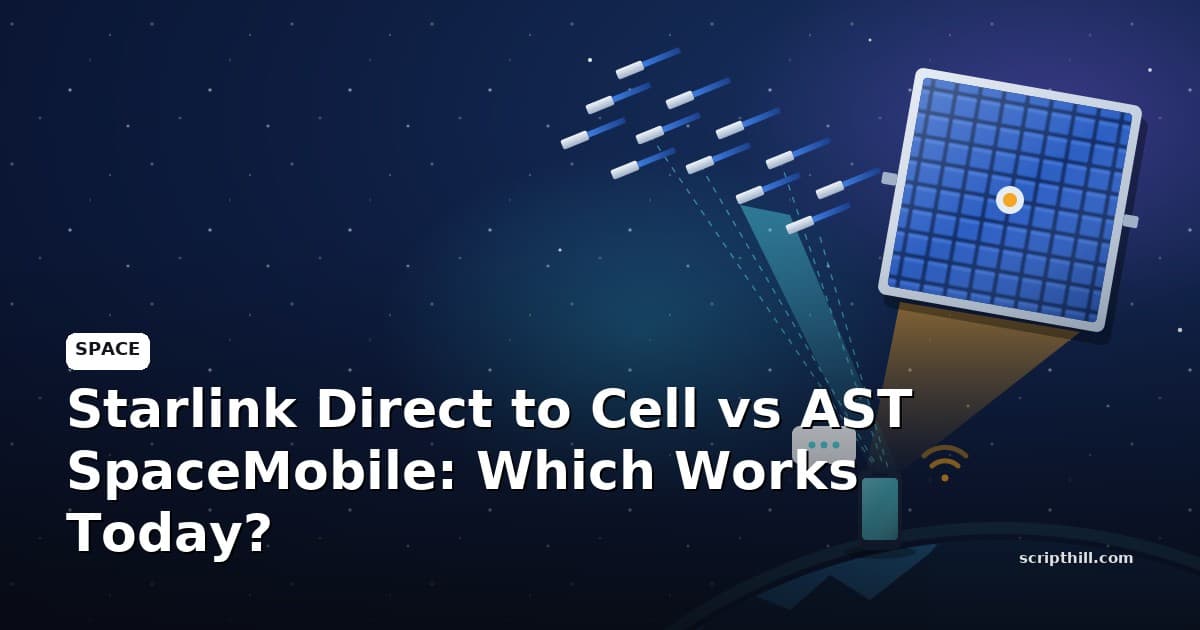
As of November 2026, Starlink Direct to Cell is the one you can actually use. "Direct to cell" means your normal phone talks straight to a satellite, with no dish or special device. Starlink's version runs on about 650 satellites and reaches customers through carriers like T-Mobile and O2. It's best at getting texts and light app data out of places with no towers.
In the Starlink Direct to Cell vs AST SpaceMobile matchup, AST is betting on size instead of numbers. It has about 12 satellites in orbit, each far larger, built to push real broadband to an unmodified phone. Until many more launch, its coverage stays patchy.
Either way, you don't get to pick. Your carrier does.
What you can use today
Starlink Direct to Cell is a live, paying service, but SpaceX doesn't sell it to you. The satellites broadcast on a carrier's spectrum, the radio frequencies that carrier is licensed to use, and the carrier sells you the service. In the US, that's T-Mobile, whose T-Satellite service launched commercially in 2025. T-Mobile has also offered it to people on other carriers, so check its current terms before assuming you're shut out. In Europe, Virgin Media O2 went first, launching commercially in the UK on Feb 26, 2026.
The biggest user numbers come from elsewhere. VEON reported on Oct 19, 2026 that over 11 million subscribers across Kyivstar in Ukraine, Beeline in Kazakhstan and Banglalink in Bangladesh had used a Starlink connection at least once.
AST SpaceMobile has strong partners: AT&T and Verizon in the US, plus Vodafone, Rakuten and Bell. But a dozen satellites can't keep any one spot covered all the time, so you'd only get a signal when one happens to pass overhead. Neither AST nor its carriers have given a firm consumer launch date.
What each service can actually do
Starlink Direct to Cell is a texting service first. Everywhere it's offered, you can send and receive SMS (the standard text messages your phone already handles) and share your location. Some markets add app data, a small allowance that lets specific carrier-approved apps work over satellite. It isn't open internet access. T-Mobile added it for a short list of apps in fall 2025, and other markets still offer text only.
Voice is murkier. A September 2026 explainer from Starlink News said no launched consumer market had satellite voice calls yet, and later claims of a voice expansion come from low-reliability sources. Ask your carrier before you count on making a call.
Don't confuse any of this with Starlink's home or RV internet. That's a separate product built around a dish you mount outside. Direct to Cell reaches the phone in your pocket through a much thinner pipe, so video calls and big photo uploads won't work.
AST SpaceMobile aims higher. Its satellites are built for full broadband, meaning normal calls, video and the apps you'd use on a tower. It made the first space-to-phone video call in 2023 with its BlueWalker 3 test satellite. How fast it will be on a busy network is anyone's guess until consumer service starts.
Why the satellites look so different
Both companies face the same physics problem. Your phone's antenna is tiny and weak, and the satellite is hundreds of kilometers overhead. They chose opposite ways to hear it.
Starlink makes each satellite behave like a cell tower in the sky. Every one carries an LTE base station (LTE is the 4G standard your phone already uses) and broadcasts in the partner carrier's licensed spectrum. For T-Mobile, that's a narrow slice of its PCS band. Your unmodified phone sees what looks like an ordinary tower and connects, as Starlink News explains in its walkthrough of how the system works.
Those satellites are small, with small antennas, and SpaceX launches them about 13 at a time. Think of hundreds of small flashlights sweeping the ground. Together they light up a huge area and fill in gaps fast, but each beam is dim and carries little data. That's why texts and light app data are the sweet spot.
AST went the other way. Each satellite unfolds a very large phased array, a flat antenna that steers its beam electronically instead of physically turning. A bigger antenna works like a big ear hearing a whisper across a room: it picks up your phone's faint signal far more clearly, so each beam can carry much more data. That's what makes real broadband to an ordinary phone plausible.
The price is time and money. Each giant satellite is expensive and slow to build and launch, and Starlink currently outnumbers AST in orbit by roughly 50 to 1.
Starlink direct to cell vs AST SpaceMobile at a glance
Only one row here is an everyday satellite service you can sign up for through a carrier, and that's Starlink. The satellite counts come from KeepTrack's tally of the direct-to-cell fleet. The FCC (Federal Communications Commission) is the US regulator that authorizes satellite fleets.
| Available now | How you get it | What works | Satellites: in orbit vs authorized | Coverage continuity | Phone requirements | |
|---|---|---|---|---|---|---|
Starlink Direct to Cell | Yes, commercially | Through a partner carrier (T-Mobile, O2 and others) | Texts, location sharing, select apps in some markets; no voice yet | About 650 in orbit. FCC added 7,500 Gen2 on Jan 9, 2026 (15,000 total), with direct-to-cell permitted | Wide, outdoors with open sky | Most recent LTE phones; future bands will need newer chipsets |
AST SpaceMobile | Not as a broad consumer service | Through partner carriers such as AT&T and Verizon | Built for voice, data and video | 12 launched (a 13th lost in April 2026); FCC approved 248 in April 2026 | Intermittent until dozens are up | Ordinary phones; support lists vary by carrier |
Apple satellite (Globalstar) | Yes | Built into supported iPhones | Emergency SOS, basic messaging | Not disclosed | Open sky required | Supported iPhone models |
Skylo | Yes | Built into supported Android phones; Verizon messaging | SOS, basic messaging | Not disclosed | Open sky required | Supported Android models; varies by carrier |
If you carry a recent iPhone or a supported Android phone, you may already have emergency texting from orbit at no extra cost. So you don't need Starlink or AST just to call for help. You'd want a carrier service for everyday texting and app data where there are no towers.
Your carrier decides for you
Since the service comes through your carrier, the company on your SIM picks the network. T-Mobile and its international partners use Starlink. AT&T and Verizon, plus other carriers abroad, are backing AST.
Pricing works the same way. According to Starlink News' explainer, carriers either bundle satellite access into premium plans or sell it as a monthly add-on in the low double digits. Those terms change often, so check your own plan instead of trusting a number from a forum post.
On AT&T or Verizon, AST is your carrier's long-term bet. In the meantime, Verizon customers with supported phones already get Skylo-based messaging. T-Mobile customers aren't locked in either. If AST or something else pulls ahead later, you can port your number like you always could.
Switch now only if dead zones are a frequent, real problem, like living on a rural property with no signal or spending most weekends far from towers. For the occasional camping trip, the phone-native SOS you may already have covers emergencies.
Before you decide, check four things. Does your carrier have a satellite partner? Is satellite included in your plan, or is it a paid add-on? Is your exact phone model on the carrier's supported list? And are kids' lines or business lines excluded? That last one catches families and small businesses off guard, so ask the carrier directly.
Limits to know before you rely on it
Satellite-to-phone service needs a wide patch of open sky. Indoors or under heavy tree cover, you'll get little or nothing. Inside a car or RV it's hit or miss, so step outside and hold still. Messages also take longer to go out than they do over a tower, so give them time before you resend, and stick to the apps your carrier has optimized for satellite.
Coverage stops at borders sooner than you'd expect, too. A US T-Satellite subscriber gets backup while roaming in Canada and New Zealand, not everywhere, and some markets offer texting only.
What the next two years could change
The real question is whether Starlink's next generation can close its capacity gap before AST has enough satellites for continuous coverage.
SpaceX's plan depends on new airwaves. In 2025 it agreed to buy EchoStar's AWS-4 and H-block spectrum, two radio bands that give it far more room than the slice it borrows from T-Mobile. The catch is that today's phones can't use those bands. They need newer chipsets, the radio chips inside the phone, so a phone you buy now may stay on texting-grade service after the faster one arrives. If satellite data is part of why you're upgrading, check whether a new model lists those bands.
The next-generation satellites are also expected to be bigger and to launch on Starship, SpaceX's giant reusable rocket, which is still flying test missions such as Flight 15. SpaceX hasn't said when they'll go up.
AST's open question isn't its antennas. It's building and launching them fast enough. The FCC has approved a 248-satellite constellation, but after losing a satellite in April 2026, AST needs a steady launch pace and a lot of funding to reach that count.
For investors, the split is simple. AST carries execution risk. SpaceX's risk is spectrum and capacity, not getting satellites into orbit.
Frequently Asked Questions
Do I need a new phone or app to text by satellite?
Usually not. Your phone treats the satellite like an ordinary cell tower, so texts go through the messaging app you already use. Keep your phone's software current, because carriers may switch the feature on through a system or carrier-settings update. Satellite data works only in carrier-approved apps, and those are regular apps you'd already have installed.
Will satellite-to-phone service ever replace normal cell coverage?
No, and neither company is pitching it that way. One satellite beam covers a huge area and splits its capacity among everyone under it, while a ground tower serves a few miles. Satellite signals also struggle to get through roofs and walls, and indoors is where most people use their phones. Even AST's broadband-class design is meant to fill the gaps between towers, not take their place.
Which one works better for you
If you need texting in dead zones right now and you're on T-Mobile or one of its partner carriers abroad, Starlink is your answer. For a hiker or a rural driver, a text that gets out slowly beats no signal at all.
On AT&T or Verizon? Don't switch carriers just for satellite. A recent iPhone or a Skylo-capable Android phone already covers SOS and basic messaging, which is enough backup for most trips unless dead zones are a weekly problem rather than a once-a-year one.
If you want real broadband from space on an ordinary phone, AST's design is the one built for it. You'll be waiting, though.
Your next step is simple: open your carrier's satellite page and confirm your plan includes it.
Sources
- Starlink Direct to Cell, Phones, Price and 650 Satellites - KeepTrack · keeptrack.space
- Starlink Direct to Cell 2026: Does It Replace Your eSIM? · wowosim.com
- Starlink Direct to Cell: How Satellite-to-Phone Works - Starlink News · starlink-news.com
- Starlink Direct-to-Cell: What Satellite Texting Means for Digital Nomads in 2026 · rentremote.com
Want more from ScriptHill in Google? Add us as a preferred source