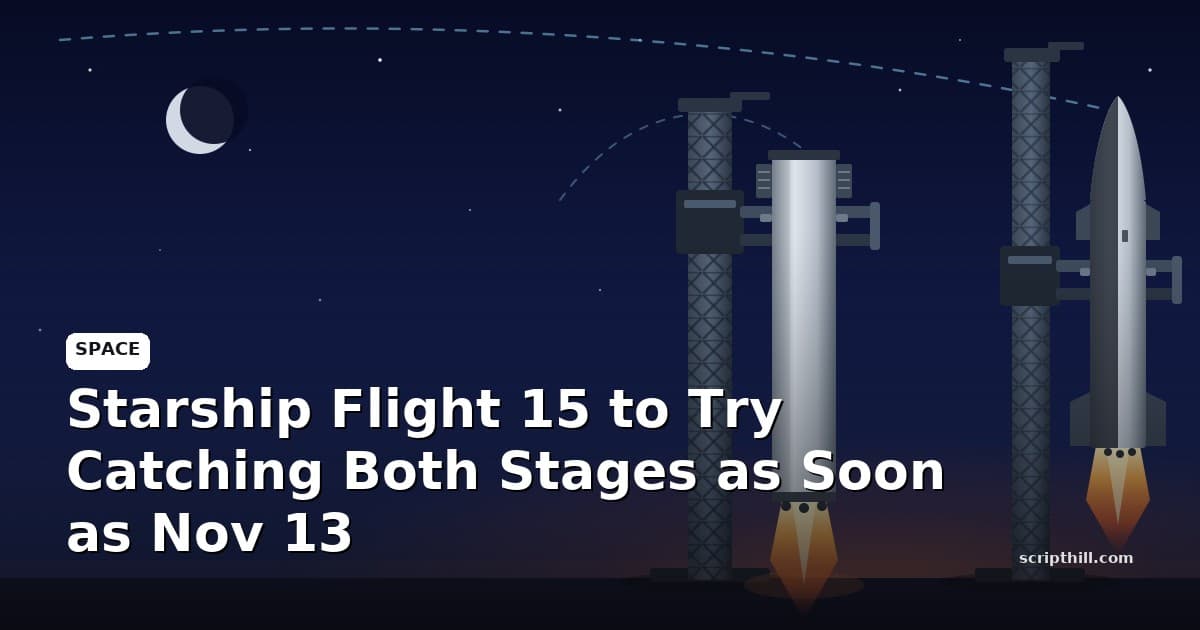
SpaceX is targeting no earlier than Friday, November 13, 2026, for Starship Flight 15, with the launch window opening at 4:45 p.m. CST (22:45 UTC) at Starbase, Texas. The launch still needs regulatory approval.
The flight is SpaceX's first attempt to catch both stages with the launch tower: the Super Heavy booster minutes after liftoff, and the Starship upper stage after more than 22 hours in orbit. If both catches work, it would be the first time every part of an orbital rocket has been recovered.
Three boosters have been caught before. No ship has, and this one comes home only if it passes a health check during flight.
When to watch the launch and catches
An on-time liftoff puts the booster catch minutes later and the ship catch the next day.
- Liftoff: 4:45 p.m. CST (22:45 UTC) Friday, Nov. 13, at the earliest.
- Window: 75 minutes, closing at 6:00 p.m. CST (00:00 UTC).
- Webcast: SpaceX's stream usually starts about 20 minutes before liftoff, according to Orbital Radar's live countdown. That's around 4:25 p.m. CST for an on-time launch.
- Booster catch: Super Heavy returns to the Pad 2 tower within minutes of liftoff.
- Ship catch: about 22 or more hours after launch, which puts it on Saturday, Nov. 14, local time. SpaceX hasn't published a landing time, so this is an estimate.
What Starship Flight 15 will do in orbit
Flight 15 uses the Starship–Super Heavy V3 configuration from Pad 2 at Starbase, Texas, and both vehicles are new. Booster 22 is making its first flight, and its return will be the first catch attempt for a V3 booster. Ship 42 finished its static fires in late October, including a full-duration firing of all six engines and a single-Raptor burn that simulated the deorbit burn the ship needs to come home.
In orbit, the ship is planned to fly at about 275 km for roughly 14 orbits. It carries 26 Starlink V3 satellites on a mission tracked as Starlink Group 31-2. Three of those satellites have cameras that will photograph Starship's heatshield from outside the vehicle and send the images to the ground.
Why catching the ship is harder
The booster has the easier trip home. After stage separation, it fires a boostback burn and falls back along a suborbital arc, reaching the tower within minutes and well below orbital speed.
The ship comes back from orbital velocity after a day in space, carrying far more energy, and has to shed most of it as heat through its shield. It reenters belly-first in a controlled fall, flips upright late in the descent, then fires a landing burn precise enough to settle it between the tower's chopsticks. Teslarati lays out that sequence. That last burn leaves little room for error.
Elon Musk called a successful ship catch "more likely than not" on the Q3 earnings call.
SpaceX can skip the ship catch
Musk's odds come with a condition. Ship 42 heads back to Starbase only if flight controllers confirm that the systems it needs for reentry, the landing burn and the tower approach are healthy. If they aren't, SpaceX's mission plan has the ship take a passively safe suborbital path or deorbit over the ocean in preset areas.
The check exists because the return path crosses inhabited parts of northern Mexico and southern Texas, where residents may see or hear the ship coming back. The camera satellites' heatshield images give controllers evidence of the shield's condition before they commit to bringing the ship over land.
The plan firmed up over the past week. Tesla North reported on Nov. 5 that a ship catch wasn't yet confirmed, and SpaceX's mission page now says it plans to catch both stages. A splashdown after a failed health check would mean the plan worked as designed, not that the flight failed.
How firm the Nov 13 date is
Nov. 13 is the earliest Starship Flight 15 can fly, and the date has already moved twice. FAA air-traffic slides first listed the launch for no earlier than Nov. 8, then Nov. 12, before a CADENA presentation pushed it back another day to Nov. 13. SpaceX VP of Launch Kiko Dontchev gave that target at UP.Summit, as reported by Eric Berger, and SpaceX confirmed it on X on Nov. 7.
Aviation notices (NOTAMs) also cover Nov. 14 through 19, giving SpaceX backup days if weather, hardware or paperwork forces a delay. Changes will appear first on SpaceX's X account and its Flight 15 mission page.
What a full recovery would mean
Recovering both stages would be a fast step for a program that reached orbit for the first time only on Flight 14, which launched Sept. 28. Flight 15 is Starship's second orbital mission.
Fast reuse of both stages is the basis of Starship's economic case. Starlink already has 11,214 satellites in orbit, and deploying the larger V3 satellites at scale depends on flying boosters and ships again quickly instead of building new ones for each launch. Later missions beyond Starlink rest on the same reuse.
A miss wouldn't leave SpaceX waiting long. Musk said more flights are already lined up if this one falls short.
Sources
- SpaceX's Starship Flight 15 delayed by a day, now likely to launch on November 13 - Starlust · starlust.org
- Starship Flight 15 · nextspaceflight.com
- Starship Starlink Group 31-2 (Starship Flight 15) launch: live countdown · orbitalradar.com
- SpaceX will perform Starship double catch attempt with Flight 15 · teslarati.com
Want more from ScriptHill in Google? Add us as a preferred source