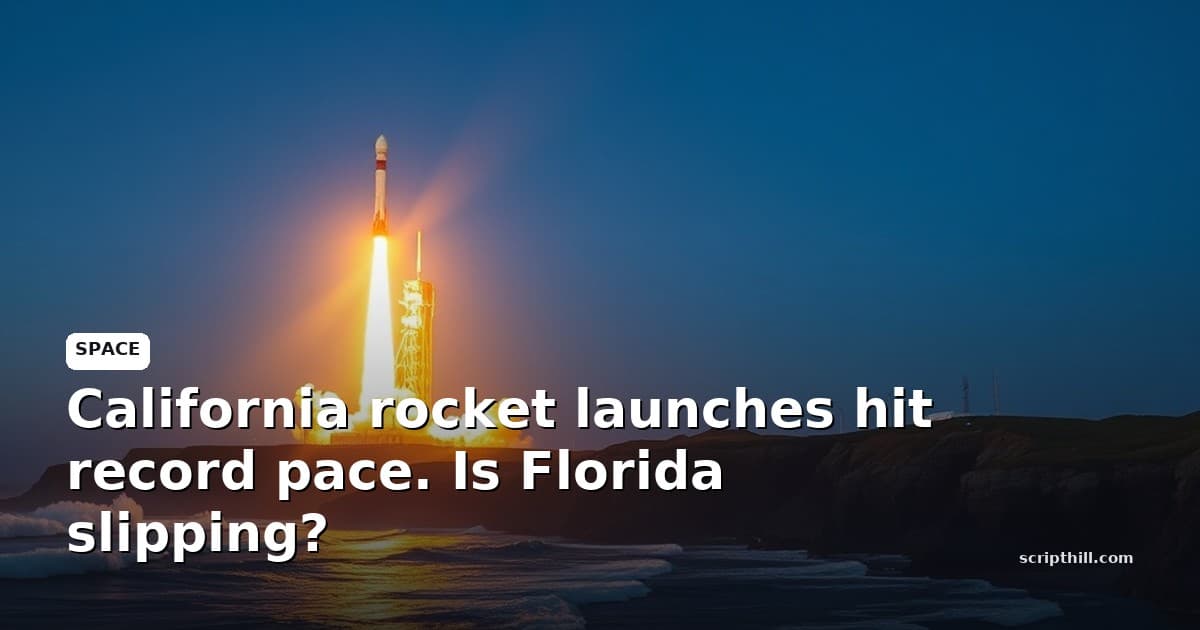
California rocket launches are running at a record pace. Vandenberg Space Force Base flew its 60th mission of 2026 by early September and is on pace to top the 71 launches it logged in 2025, the base's previous high. Nearly all of that growth comes from SpaceX's Falcon 9.
That doesn't mean Florida is fading. Cape Canaveral and Kennedy Space Center supported a record 109 orbital launches in 2025. What's changing is California's share of U.S. launches. Florida's real trouble this year came from Blue Origin, whose New Glenn failed twice in the spring and left the Cape without its main second launch provider.
Florida is still launching at a record clip
That 2025 total, supported by Space Launch Delta 45, was the most in the Florida range's history. In late October the unit's commander, Brian Chatman, described the current stretch to Axios as a "boom cycle," and Axios reports that Cape launch rates now exceed those of the Cold War-era space race, long treated as the high-water mark for Florida spaceflight.
California's best year looks modest beside that. Vandenberg's 71 launches in 2025 trailed Florida by 38, and even a 2026 total well past that would still fall short of the Cape's 2025 mark. No verified figure shows Florida launching less in 2026.
Comparisons between the coasts tend to go wrong in two ways. SLD 45's count covers both Cape Canaveral Space Force Station and NASA's Kennedy Space Center, so a tally limited to the Cape Canaveral pads will undercount Florida. Government figures are also sometimes reported by federal fiscal year, which begins Oct. 1, while most launch trackers use calendar years. Mixing the two can make either coast appear to have gained or lost launches it didn't.
Why SpaceX is flying more from Vandenberg
Geography decides where most Falcon 9s fly from. Rockets leaving Vandenberg head south over the open Pacific, the natural path into polar and sun-synchronous orbits that carry satellites over or near the poles. Florida launches fly east over the Atlantic, which suits lower-inclination orbits, geostationary satellites, crewed flights and deep-space missions.
Much of SpaceX's current workload needs the steep orbits. Starlink's high-inclination shells require them, as do many national-security payloads, including Space Development Agency and National Reconnaissance Office constellations. Each push to fill those shells sends more Falcon 9 flights to California, however busy Florida's pads are.
The base is adding room for that traffic. Space Launch Delta 30, which runs Vandenberg, plans to add more launch complexes.
SpaceX's own operational choices shape the count on both coasts too: how fast crews can turn a pad around between flights, how many boosters are ready to fly, and which pads the company takes offline for conversion to other vehicles. Moving boosters west can raise Vandenberg's total without anything going wrong in Florida.
New Glenn was Florida's real setback
The Cape's problem in 2026 wasn't volume. It lost the vehicle meant to give it a second high-cadence provider alongside SpaceX.
New Glenn failed twice in about six weeks. On April 19, its second stage didn't reach the intended orbit, and the FAA opened an investigation. Then on May 28, a New Glenn exploded during a static-fire test at Launch Complex 36 at Cape Canaveral, damaging the pad Blue Origin uses.
Blue Origin CEO Dave Limp said afterward that he expected New Glenn to fly again before the end of 2026, and that production would continue, with finished stages held in storage until the rocket returns. That goal now looks out of reach: Blue Origin has pushed its next launch target to January 2027.
Because New Glenn had barely begun flying, the grounding doesn't cut much from Florida's 2026 total. The bigger loss is future capacity. The Cape now depends heavily on Falcon 9, with United Launch Alliance as its only other active provider. If SpaceX has a problem or shifts its own priorities, nobody else can keep Florida's pads busy.
What could put Florida back in front
Florida's best path back to the front runs through new rockets, not through taking missions from California. Relativity Space and Stoke Space are both building facilities at the Cape and aim to start launching in late 2026 or 2027. Either could fill the gap New Glenn left.
Starship won't change the count yet. SpaceX has done most of its development flying at Starbase, Texas, so the program adds nothing to Florida's total for now.
The larger reason the coasts aren't in a zero-sum fight is demand. The administration wants the country able to support 1,000 launches a year by 2030. The FAA's July 2026 10-year forecast is more modest but still steep, projecting nearly 4,300 U.S. launches from 2026 to 2036 and more than 500 a year by the end of that span.
According to Axios, the Cape and Vandenberg together can't fully absorb that expected demand, which leaves the Cape as the "linchpin" until new spaceports open and gives both coasts room to keep setting records.
Vandenberg's neighbors want a say
Vandenberg's growth has a limit that new launch complexes can't fix: its neighbors. The California Coastal Commission and nearby communities have pushed back on the base's expansion, mostly over sonic booms and the effects of launch activity on the coastline. The Ventura County Star's report on California's launch boom directly invites residents to give public input on future launch plans.
Launch-watchers face a simpler problem. Schedules are often published only shortly before liftoff, so a trip planned weeks ahead can miss the launch, and checking close to the date is more reliable.
A record cadence means more booms over the same coastal towns, which will sharpen the dispute. How far Vandenberg climbs past its record may depend as much on regulators and residents as on Falcon 9 demand.
Sources
- Cape Canaveral in its "boom cycle" of launches · axios.com
- 2026 New Glenn rocket explosion · en.wikipedia.org
- California rocket launches are booming. How you can shape what's next · bluewaterhealthyliving.com
Want more from ScriptHill in Google? Add us as a preferred source