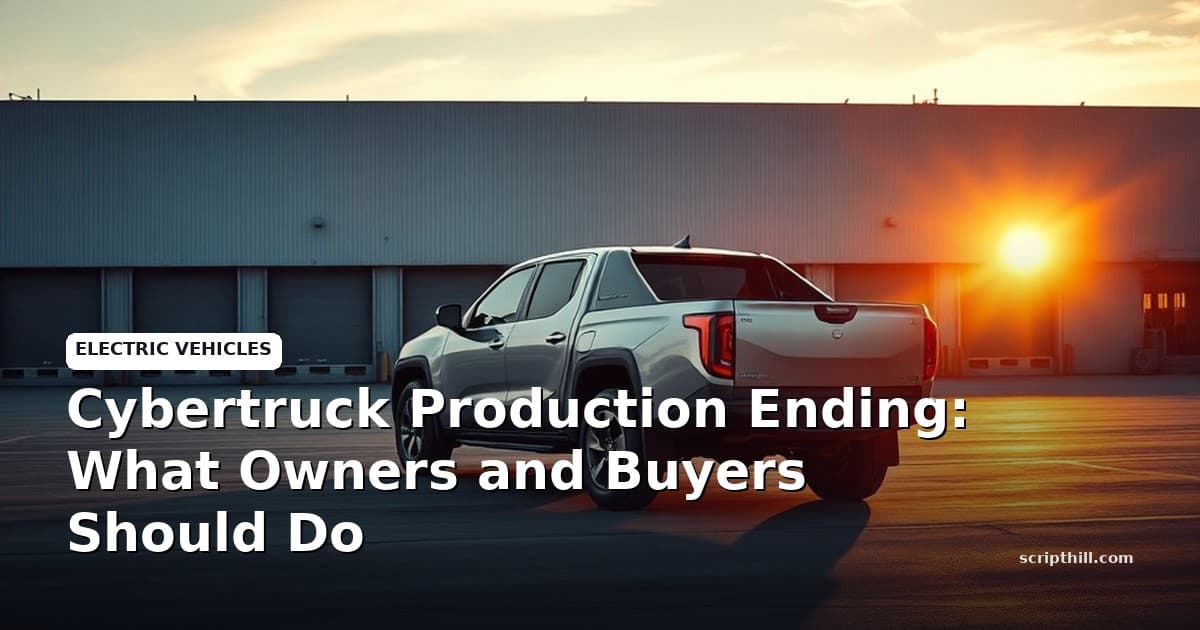
On November 6, 2026, Elon Musk posted on X that Tesla "will be winding down production of the Cybertruck at Gigafactory Texas around the middle of next year to make room for increased Cybercab production." That puts a rough timeline on Cybertruck production ending in Austin, even though Tesla hasn't called the truck discontinued. Austin is the only known Tesla plant equipped to build it, so the end of production there around mid-2027 will most likely mean the end of new Cybertrucks.
The post left a lot out: no firm end date, no production volumes, nothing about existing orders. Below is what Musk actually said, what's still missing, why Tesla is doing this, and what owners and buyers can do now. As of November 2026, details are thin and could change within days.
What Musk Said About the Cybertruck, and What He Didn't
Tesla "will be winding down production of the Cybertruck at Gigafactory Texas around the middle of next year to make room for increased Cybercab production."
Elon Musk, post on X, November 6, 2026
According to MLQ's summary of the coverage, The Verge broke the story and Musk's post confirmed it. The wording is narrow: one factory, an approximate window and a stated reason. The word "discontinue" doesn't appear.
In replies to users, Musk added that the "Cybertruck fleet will be around for a long time," called the truck the "best vehicle Tesla has ever made" and described the wind-down as the "end of an era." Owners may take the fleet comment as a promise of support. It's one sentence in a reply thread, though, not a commitment on parts or service.
The post skips the details that matter most to anyone with money on the line. "Around the middle of next year" points to mid-2027, but no date is attached, and there are no figures for how many trucks Tesla will build before then.
Still unconfirmed, as of November 2026:
- A firm end date for production in Austin
- Production volumes between now and the wind-down
- How Tesla will handle existing orders and saved configurations
- Whether Cybertruck production moves to another plant or stops entirely
Is the Cybertruck Being Discontinued?
Not officially, though new production will probably end in 2027. Musk's post refers to "winding down production of the Cybertruck at Gigafactory Texas," which is narrower than ending the model. Tesla hasn't announced that, and calling the Cybertruck "dead" goes beyond anything the company has confirmed.
The sticking point is where else it could be built. Austin is the only known Tesla plant equipped to make the truck's specialized parts, including its stainless steel body panels. Tooling up a second factory for a low-volume truck that Tesla is pushing out of Austin to make room for robotaxis would be hard to justify.
So the realistic reading is that new Cybertruck production is ending, even if the official status stays open. The timing is soft as well. Musk's timelines often slip, and the wind-down could run past mid-2027 if Cybercab demand ramps slowly or Tesla schedules a final batch of trucks.
Why Tesla Is Doing It: Factory Space and Weak Demand
Musk framed the decision around floor space. Gigafactory Texas has finite room, and the lines, presses and tooling behind a low-volume stainless-steel pickup could be building Cybercabs instead. Tesla is betting that a driverless two-seater collecting fares many times a day will earn more per square foot than a truck that makes its margin once, when it's sold. That only works if demand for robotaxi rides turns out to be large, which Tesla hasn't shown yet.
The sales figures supply the other half of the explanation:
- 8,295 vs. 12,364: "Other Models" deliveries in Q3 2026 versus Q2 2026, as of November 2026. Tesla doesn't report the Cybertruck separately and counts it in this category, so any truck-only sales figure is an estimate. (Tesla delivery report via Tradingpedia's coverage of the wind-down)
- 250,000–500,000 a year: Musk's estimate at the May 2023 shareholder meeting of eventual annual Cybertruck sales. Four quarters at the Q3 pace for the whole category would land far below the low end of that range. (Forbes)
- $39,900 → $59,900: The 2019 unveiling promised $39,900. The cheapest version eventually cost $59,900. (Forbes; Engadget)
- About $70,000: A cheaper trim reported in 2025. Current trims and prices should be checked on tesla.com. (Fortune)
- Early-2025 reporting: Tesla recalled every Cybertruck over a body panel issue, one of eight recalls in about 15 months. Some production teams were cut by more than half, and workers were moved to the Model Y line. (Fortune, citing Business Insider)
Weak demand makes the robotaxi bet cheaper to place. Had the truck been selling anywhere near Musk's forecast, handing over its floor space would have been an expensive trade. At current volumes, Tesla gives up relatively little. For investors, the open question is whether the Cybercab can fill that space profitably.
How We Got Here: Cybertruck and Cybercab Timeline
The truck's decline and the robotaxi's rise overlap more than the headlines suggest.
- November 2019: Cybertruck unveiled with a promised $39,900 price for 2021, and refundable $100 reservations open.
- May 2023: Musk says Tesla could eventually sell 250,000–500,000 trucks a year.
- 2023: Production starts after repeated delays, and deliveries begin in November.
- October 10, 2024: Cybercab unveiled, with Musk targeting at least 2 million a year across more than one factory.
- Early 2025: Reports say staff are moved off Cybertruck lines, and Tesla recalls every truck over a body panel issue.
- February 2026: The first Cybercab production vehicle is built.
- April 2026: Cybercab production starts.
- September 3, 2026: Cybercab launch event, with paid public rides beginning in Austin that month.
- Q3 2026: "Other Models" deliveries, which include the Cybertruck, fall to 8,295 from 12,364 in Q2.
- November 6, 2026: Musk announces the Gigafactory Texas wind-down.
- Mid-2027 (target, not confirmed): Musk's stated timing for the wind-down. As of November 2026, Tesla hasn't given a firm end date.
What the Cybercab Is, and How Far Along It Is
The Cybercab is a two-seat robotaxi with no steering wheel or pedals, built to carry paying passengers without a human driver. Tesla unveiled it on October 10, 2024, started production in April 2026 and began charging for public rides in Austin in September 2026. TeslaNorth reports Cybercabs now operating in both Austin and Dallas.
It shouldn't be confused with Tesla's Robotaxi rides in Model Y vehicles. Those trips use modified versions of an existing SUV, while the Cybercab is a separate, purpose-built car.
The fleet is still small. As of November 2026, Wikipedia's Tesla Cybercab entry lists about 319 registered in Texas, a snapshot rather than an official production figure, and one that could change within weeks. Musk's goal, set in October 2024, is at least 2 million Cybercabs a year across more than one factory. Getting from a few hundred vehicles to millions takes a great deal of assembly space, and in Austin the obvious place to find it is the line building the Cybertruck today.
What Cybertruck Production Ending Means for Current Owners
The closest thing to a support promise is Musk's reply on X that the "Cybertruck fleet will be around for a long time". It's encouraging, but it isn't a commitment. As of November 2026, Tesla hasn't said how long it will supply parts or support the truck once the line stops, so owners shouldn't count on any particular number of years.
Service and parts
Little of the Cybertruck's body is shared with other Teslas. The stainless steel panels, 48V low-voltage system and steer-by-wire steering are unique to it. For most owners, collision damage is a bigger risk than a mechanical failure: once new panels and glass stop coming off the line, bodywork, windshield replacement and crash repairs could take longer or cost more. Owners should check whether their insurance covers repairs to the stainless body and whether an approved shop nearby can handle the work.
Warranty
Ending production doesn't rewrite existing contracts. The basic warranty and the battery and drive unit warranty stay on the terms in effect at purchase. Owners should hang on to the purchase agreement and warranty documents, since those settle any later dispute over coverage.
Software updates
Nothing Musk has posted suggests over-the-air updates will stop. Long-term parity with other Teslas is another matter. A low-volume model with its own electrical and steering hardware may get new features late or not at all as engineering attention moves to the Cybercab.
Supercharger access and the Tesla app are tied to the vehicle and the owner's account, not to whether the factory is still building the truck.
Will Your Cybertruck Lose Value?
Some near-term softness is likely. Production-ending news tends to make used-car shoppers cautious, and if Tesla discounts its remaining new inventory to clear it before mid-2027, those trucks will compete directly with used ones. Parts worries add a second drag. Used buyers will price in the risk that stainless body panels, glass or steer-by-wire components get harder to source, and that a minor collision means a long wait at the body shop.
Further out, the picture is murkier. Low-mileage early trucks and Foundation Series examples could eventually draw collector interest as survivors of an unusual design, but that's a possibility, not something to plan a sale around. Owners who expect to sell within the next year shouldn't wait to find out. Trade-in and private-sale quotes gathered now give a baseline before final-run discounts hit the market.
Owner Checklist: Do These Now
Most of these steps can be finished before the wind-down reaches the parts supply chain.
- Save copies of the basic warranty and the battery and drive unit warranty, including coverage end dates and mileage limits.
- Ask the local service center how long it expects to stock stainless body panels, glass and other truck-specific parts, and write down the answer and the date.
- Request insurance quotes that explicitly cover repairs to the stainless steel body, not just generic collision coverage.
- Check the VIN on NHTSA's recall lookup for open recalls, and book any outstanding fixes.
- Install pending software updates and keep every service record, since a documented history helps at resale.
Buy Now, Wait for the Final Run, or Skip It?
| Option | Price/discount | Build maturity | Parts & service outlook | Resale outlook | Best for |
|---|---|---|---|---|---|
Buy now | Current pricing, with modest inventory deals possible; deeper cuts more likely later | Benefits from fixes made since deliveries began in 2023 | Longest ownership period while the truck is still in production | Exposed to near-term pressure from the wind-down headlines | Buyers who need a truck soon and want this one specifically |
Wait for final-run discounts | Likely the largest discounts as Tesla clears remaining inventory | Most mature build, with the run's accumulated fixes | Same truck-specific parts, but ownership starts closer to the end of production | A lower purchase price cushions depreciation; collector interest is possible but speculative | Patient, price-focused buyers who can live with timing risk |
Skip it for another electric pickup | Depends on the rival's pricing and incentives | Varies by model and maker | Better if the maker still builds and supports that truck | Avoids the discontinued-model discount | Buyers who put long-term parts and repair access first |
The choice mostly turns on how long a buyer plans to keep the truck. Someone trading in within a few years can treat a final-run discount as a bargain. Someone keeping it for a decade is betting on how long Tesla stocks stainless panels, glass and the other parts unique to this truck. Musk's post said nothing about existing orders, so as of November 2026, anyone holding one should ask Tesla in writing whether delivery before mid-2027 is guaranteed and what happens to the deposit if it isn't.
Buyer Checklist Before You Sign
Shoppers close to a purchase should work through five checks before any money changes hands.
- Get written confirmation that delivery lands before the mid-2027 wind-down, plus refund terms if it slips.
- Weigh any inventory discount against a resale price that could sag as headlines and parts questions linger.
- Confirm current trims and prices on tesla.com. The entry price has moved repeatedly since the $39,900 promised in 2019.
- Verify current federal EV tax credit rules, since eligibility has changed, rather than relying on a forum summary.
- Ask whether FSD transfer offers or other perks apply to this specific truck.
Other Electric Pickups to Consider
| Truck | Best for | Supercharger/NACS access | Availability note | Support outlook |
|---|---|---|---|---|
Rivian R1T | Off-road and adventure buyers who want a smaller, quick truck | Adapter access; check whether a given build has a native NACS port | Sold as a core model; confirm current trims | Central to Rivian's lineup, though Rivian is a younger company with less of a track record |
Chevrolet Silverado EV | Work and fleet buyers who want a conventional full-size layout | Adapter access; confirm the port type for the model year | Generally available; inventory varies by dealer | Strong, with GM's dealer and parts network behind it |
GMC Sierra EV | Buyers who want Silverado-style capability with a more upscale cabin | Adapter access; confirm the port type for the model year | Generally available; check dealer stock | Strong, since it shares a platform with the Silverado EV |
GMC Hummer EV Pickup | Buyers who want a statement truck with off-road hardware | Adapter access; confirm the port type for the model year | Available, but it's a niche, low-volume model | Moderate. It's backed by GM's network but sells in small numbers |
Ford F-150 Lightning | Buyers who want a familiar F-150 with an electric drivetrain | Adapter access through Ford's Supercharger arrangement | Ford has reportedly changed its plans for the truck, so confirm whether new units are still built or only inventory remains | Uncertain for new production. Parts are likely helped by F-150 commonality |
Specs, prices and lineups shift often, and the table reflects conditions as of November 2026. Ram has also reportedly cancelled or reworked its electric pickup, so buyers should check each maker's site and a local dealer before shortlisting anything. Given the Cybertruck news, the support column deserves the most weight. A truck that shares parts with a high-volume model, or sits at the center of its maker's plans, is less likely to leave owners waiting on body panels or glass years from now.
Frequently Asked Questions
Will the Cybertruck keep working with Superchargers and the Tesla app after production ends?
Nothing in Musk's announcement suggests otherwise, but Tesla hasn't made a formal commitment. Supercharger access and app features depend on the vehicle and the owner's account, not on an active assembly line. Musk's remark that the fleet will be around for a long time isn't a published support period, so owners shouldn't assume a set number of years of software updates or connectivity until Tesla states one.
If I have an open Cybertruck order, can I cancel and get my deposit back?
That depends on the terms attached to the specific order. As of November 2026, Tesla hasn't said how it will handle existing orders after the wind-down. The original 2019 reservations carried a refundable $100 deposit, but later order fees came with their own conditions, and those have changed over time. Buyers should check the agreement in their Tesla account and get the refund terms confirmed in writing before canceling.
Is Tesla planning a Cybertruck successor or a smaller pickup?
Not so far. Musk's post covered only the Austin wind-down and the shift toward Cybercab production. As of November 2026, Tesla hasn't confirmed a replacement truck, a smaller pickup or a plan to build the Cybertruck at another plant, so talk of a successor is speculation for now. The Q4 2026 earnings call, expected in January 2027, is the likeliest place for Tesla to address it.
Does the Cybertruck wind-down affect Model Y production at Gigafactory Texas?
Tesla hasn't said so. Musk gave the reason as freeing space for more Cybercab production, and his post didn't mention the Model Y. The two vehicles already share the Austin plant, and reporting from early 2025 said some Cybertruck workers had been moved to the Model Y line, so shifting staff between lines isn't new. Any change to Model Y output would have to come from Tesla directly.
What to Watch Before Mid-2027
Musk's post set a direction, not a schedule. Most of the questions left open on November 6 will be settled through official channels rather than replies on X, and the ones that matter most to owners and shoppers involve orders, pricing and support.
Signals to watch:
- Tesla's Q4 2026 delivery report and earnings call in January 2027. The "Other Models" figure will show whether deliveries kept falling from Q3's 8,295. Analysts are likely to press for an end date and a parts commitment.
- Changes to the Cybertruck order page on tesla.com. Dropped trims, new discounts or shifting delivery estimates may reveal the real pace of the wind-down before any announcement does.
- Any statement about moving production elsewhere. Austin is the only known Tesla plant equipped for the truck's specialized parts, so a relocation would be a surprise.
- Cybercab expansion to new cities and volume figures. A slow robotaxi ramp would weaken the floor-space argument and could keep the Cybertruck line running longer.
Bottom line: owners should lock in parts access and insurance coverage for stainless-body repairs while the truck is still in full production. Buyers should get delivery dates and pricing in writing before signing. Mid-2027 is a target, and it could still move.
Sources
- Tesla to wind down Cybertruck production at Texas factory as it struggles to win appeal · centraloregondaily.com
- Tesla Winds Down Cybertruck Production at Texas Factory · tradingpedia.com
- Tesla Cybercab · en.wikipedia.org
- Tesla will wind down Cybertruck production in Texas by mid-2027 to make room for Cybercab · mlq.ai
Want more from ScriptHill in Google? Add us as a preferred source