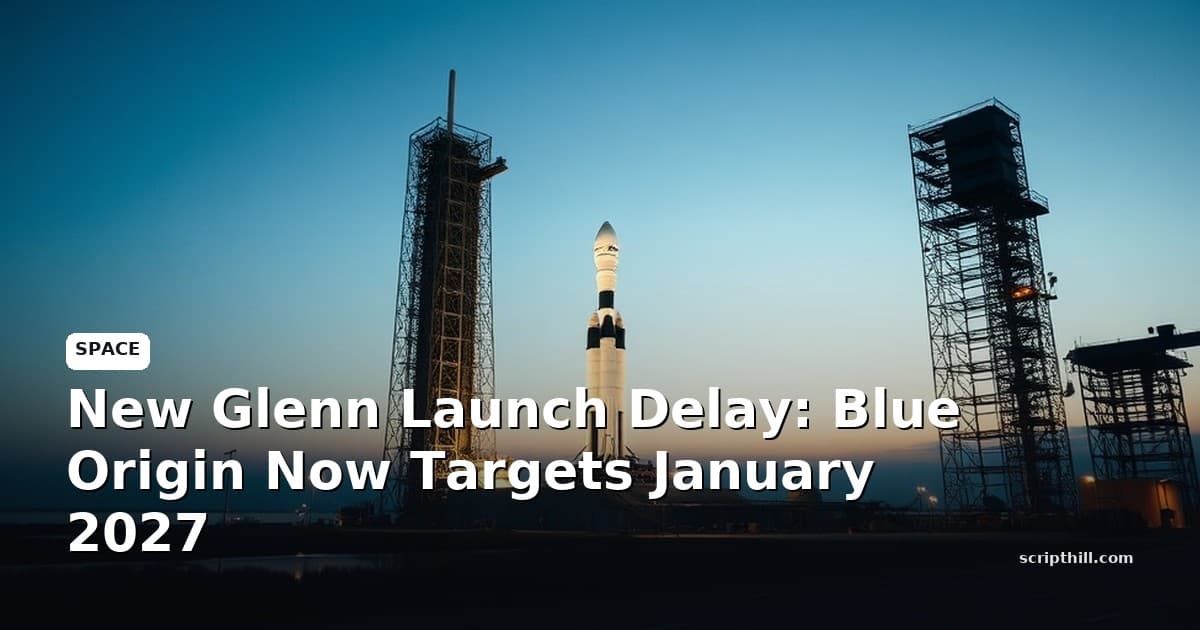
Blue Origin has pushed New Glenn's next launch to January 2027, according to an internal memo from CEO Dave Limp first reported by the Financial Times on November 5. This New Glenn launch delay comes without a specific date or payload, and it replaces the company's earlier goal of flying again before the end of 2026.
Reuters and Bloomberg have since confirmed the memo, which went to employees on November 4. The rocket has been grounded since it exploded during a hot-fire test on LC-36A, its only launch pad, in May 2026. The explosion came days before New Glenn was due to carry Amazon satellites to orbit.
What follows covers the repairs completed as of November 2026, the impact on Amazon Leo, and whether January will hold.
What Blue Origin's memo says about the January target
The Financial Times broke the story on Thursday, November 5, 2026. Reuters then confirmed it through two people familiar with the matter and an internal memo from CEO Dave Limp. Bloomberg separately reported that Limp told employees on Wednesday, November 4, that the company now targets early 2027. Three outlets with their own sourcing point to the same memo. The shift is confirmed and doesn't rest on a single anonymous report.
The memo doesn't name a launch day. As of November 2026, Blue Origin hasn't published a specific date or window for New Glenn's return. According to Bloomberg, the company had been pushing to fly again before the end of 2026. Engadget notes that this was a goal Limp had pitched on the expectation that repairs would be quick. January replaces it as the working target, but for now it's a month and not a scheduled launch.
Limp framed the change this way:
"Returning New Glenn to flight remains our top priority."
Dave Limp, Blue Origin CEO, in an internal memo to employees, as reported by Talk of Titusville
Timeline: from New Glenn's debut to the January 2027 target
- Jan 13, 2025: New Glenn's maiden launch attempt is scrubbed at Cape Canaveral, extending a run of delays to the first flight.
- 2025: New Glenn debuts. After that debut, the 322-ft (about 30-storey) rocket lifts off three times.
- May 2026: The rocket explodes on LC-36A during a hot-fire test, days before it was due to carry Amazon satellites to orbit. It was on the pad, not in flight, and LC-36A was the company's only launch pad.
- June 30, 2026: Limp publishes the return-to-flight plan. It drops the transporter erector, and the stages will now be mated inside the horizontal integration facility next to the pad.
- August 2026: Blue Origin announces Launch Complex 36B for the larger New Glenn 9x4. The current 7x2 stays at LC-36A.
- Nov 4, 2026: Limp's memo tells staff the target is now early 2027.
- Nov 5, 2026: The Financial Times reports the delay. Reuters and Bloomberg confirm it.
- January 2027: This is the new target. As of November 2026, no launch date has been set.
What happened on the pad in May
The most common error in coverage of New Glenn is the claim that the rocket blew up in flight. It didn't. The vehicle exploded on the ground at Launch Complex 36A in Florida during a hot-fire test, in which the engines are fired while the rocket is held down on the pad. It was days away from a mission carrying Amazon satellites.
New Glenn stands 322 ft tall, roughly 30 storeys, and the blast badly damaged the pad beneath it. The pad damage hurt Blue Origin more than the loss of one vehicle. LC-36A was the company's only launch pad, so it had nowhere else to fly from. CEO Dave Limp initially said repairs would be quick and that New Glenn would return before the end of 2026.
As of November 2026, Blue Origin hasn't publicly detailed the root cause of the explosion or released any investigation findings. Any explanation beyond the basic sequence of events is speculation.
Repair status: what's rebuilt and what's still ahead
According to Limp's internal memo as reported by Reuters, the main structures at LC-36A are back in place as of November 2026, but the steps that would prove the pad is ready haven't been publicly reported.
| Component | Status | Source |
|---|---|---|
Vehicle Access Tower | Repaired and restacked | Limp memo, Nov 4 (via Reuters) |
Launch bridge | Restored | Limp memo, Nov 4 (via Reuters) |
Transporter erector | Dropped; stages will be mated inside the horizontal integration facility next to the pad | Return-to-flight plan, June 30 |
Integrated vehicle and pad testing | Not publicly reported | No public update |
Static fire on the repaired pad | Not publicly reported | No public update |
Vehicle rollout for the next flight | Not publicly reported | No public update |
Limp blamed summer weather for the slower-than-promised repairs, but that explanation comes from the company and hasn't been independently corroborated.
How the launch setup changed after the explosion
The June 30 return-to-flight plan and the August announcement of a second complex changed how New Glenn gets to the pad, according to Talk of Titusville's summary of the memo.
| Stage integration | Launch pads | Vehicles served | Backup pad for the 7x2 | |
|---|---|---|---|---|
Before May 2026 | Stages handled with a transporter erector | LC-36A only | New Glenn 7x2 | None |
After the June 30 plan | Transporter erector dropped; stages mated inside the horizontal integration facility next to the pad | LC-36A, plus LC-36B (planned, announced August 2026) | 7x2 from LC-36A; larger 9x4 planned for LC-36B | Still none, because LC-36B is meant for the 9x4 |
Mating the stages in the hangar removes a large piece of equipment from the pad. If something fails during a test or countdown, less hardware sits in the blast zone. The catch is that Blue Origin hasn't yet flown with this workflow. Integrating the stages indoors and then moving the assembled vehicle out is a new sequence, and new sequences usually reveal their problems during rehearsals rather than on paper. The second pad also leaves the current rocket's single-pad gap open. If LC-36A goes down again, the 7x2 has no other pad to fly from.
Why one pad grounded Blue Origin's whole orbital business
New Glenn's problem was never just the rocket. Blue Origin had one orbital launch pad, so when the vehicle exploded there during a hot-fire test in May, the company's entire orbital business stopped with it. If the January 2027 target holds, that grounding will have lasted more than eight months. The time has gone into rebuilding the ground systems the rocket can't fly without.
SpaceX doesn't carry the same exposure. It flies Falcon from several pads, so damage at one site slows its schedule without halting it. Redundant pads are expensive to build and staff, but they turn a pad accident from a company-wide stoppage into a local setback.
LC-36B narrows that gap over time. It's being built for the larger 9x4, though. The 7x2 that flies today's customers still depends entirely on LC-36A.
That context frames the latest slip. Moving from "before the end of 2026" to January costs only a few weeks. The weaker part was the original promise. Engadget notes that Limp had said repairs would be quick, with a launch before year-end. That target came days after the explosion, while the pad was still badly damaged, and it was aggressive from the start.
What the New Glenn launch delay means for Amazon Leo
Amazon has the most riding on New Glenn. Its Amazon Leo constellation, formerly Project Kuiper, is the company's bid to compete with SpaceX's Starlink in satellite broadband, and Amazon relies on Blue Origin as a key launch provider. The timing of the May explosion made that dependence obvious: New Glenn was days away from carrying Amazon satellites into orbit when the pad was wrecked.
The hit to Amazon is real but contained. Amazon split its launch purchases across ULA, Arianespace and SpaceX as well as Blue Origin. Buying rides from SpaceX means relying on its direct broadband rival. That hedge now looks prudent, because losing one rocket slows deployment without stopping it. Each month New Glenn stays grounded is capacity Amazon has to find on another provider's vehicle or wait out.
As of November 2026, there's no reporting on how the slip affects Amazon's regulatory deadlines. The payload for the January flight also hasn't been confirmed, so it's unclear whether Amazon satellites will be aboard when New Glenn returns.
Will January hold? Signs to watch
Treat January as a target, not a date. Blue Origin set its first return-to-flight goal soon after the May explosion and missed it. First flights after a pad rebuild often slip again as integration problems surface late. The reported memo from Dave Limp names a month but no specific day.
- A named launch window. A public statement from Blue Origin with a date or window would be firmer than "early 2027" relayed through a leaked internal memo.
- FAA and range notices for LC-36A. Airspace and maritime hazard notices tied to Launch Complex 36 are among the most concrete public signs that a launch attempt is actually being scheduled.
- A static fire on the repaired LC-36A. A hot-fire test would show that the restacked Vehicle Access Tower and restored launch bridge can handle full engine loads. That's the same kind of test that ended in the May explosion, so a clean result matters.
- Vehicle rollout to the pad. Under the June 30 plan, the stages are mated inside the horizontal integration facility instead of on a transporter erector. The first stacked rocket leaving the hangar will test that new workflow.
- Payload confirmation. As of November 2026, the January payload isn't public. A named customer, especially Amazon Leo, would point to a schedule firm enough to commit hardware to.
If none of these signals appear by mid-to-late December, expect another slip.
Frequently Asked Questions
What payload will New Glenn carry on its January 2027 flight?
Blue Origin hasn't said. As of November 2026, the payload for the January flight isn't public. The rocket was days away from launching Amazon satellites when it exploded on the pad in May, so readers may assume Amazon is next in line. Neither company has confirmed that. A formal payload announcement, usually paired with a launch window, would be one of the clearer signs that the January target is firming up.
Can people watch the next New Glenn launch from the Space Coast?
Yes, once a launch is actually scheduled. New Glenn flies from Launch Complex 36 at Cape Canaveral, and launches there are generally visible from public areas along Florida's Space Coast. There's no date yet, only a January 2027 target. Spectators should follow Blue Origin's official channels and watch for FAA and range hazard notices. Those notices tend to show up shortly before a real attempt, and plans built around a target date can easily be undone by another slip.
Does the New Glenn delay affect NASA missions or the Blue Moon lunar lander?
There's no confirmed reporting on that yet. Blue Origin holds NASA and Space Force contracts, and New Glenn is the rocket Blue Origin plans to use for Blue Moon. Even so, as of November 2026 neither the company nor NASA has said how the grounding changes any specific schedule. Any knock-on effects would most likely surface in later NASA or Blue Origin updates, not in the internal memo behind the latest delay.
The bottom line on New Glenn's return
Moving from "before the end of 2026" to January costs Blue Origin only a few weeks. The bigger problem is structural. As of November 2026, the 7x2 still flies from a single pad, LC-36A, and another failure there would ground it again. Amazon Leo feels the delay most, because Amazon counts on Blue Origin as a key launch provider and hasn't had that capacity since May.
Blue Origin hasn't announced a launch date or named the January payload. This article will be updated as concrete signals appear, starting with FAA and range notices for Launch Complex 36 and any static fire on the repaired pad.
Space Coast spectators shouldn't plan trips around "January" yet. A confirmed window will come through Blue Origin's official channels. Until one is posted there, the safer choice is to hold off on nonrefundable travel.
Sources
- Blue Origin Pushes New Glenn Rocket Launch to January, Sources Say · usnews.com
- Bezos-Backed Blue Origin Delays Rocket Launch to January After May Explosion - Bloomberg · bloomberg.com
- Blue Origin's New Glenn launch delay will continue into 2027 - Engadget · engadget.com
- Blue Origin's New Glenn rocket at Cape Canaveral · techcrunch.com
Want more from ScriptHill in Google? Add us as a preferred source