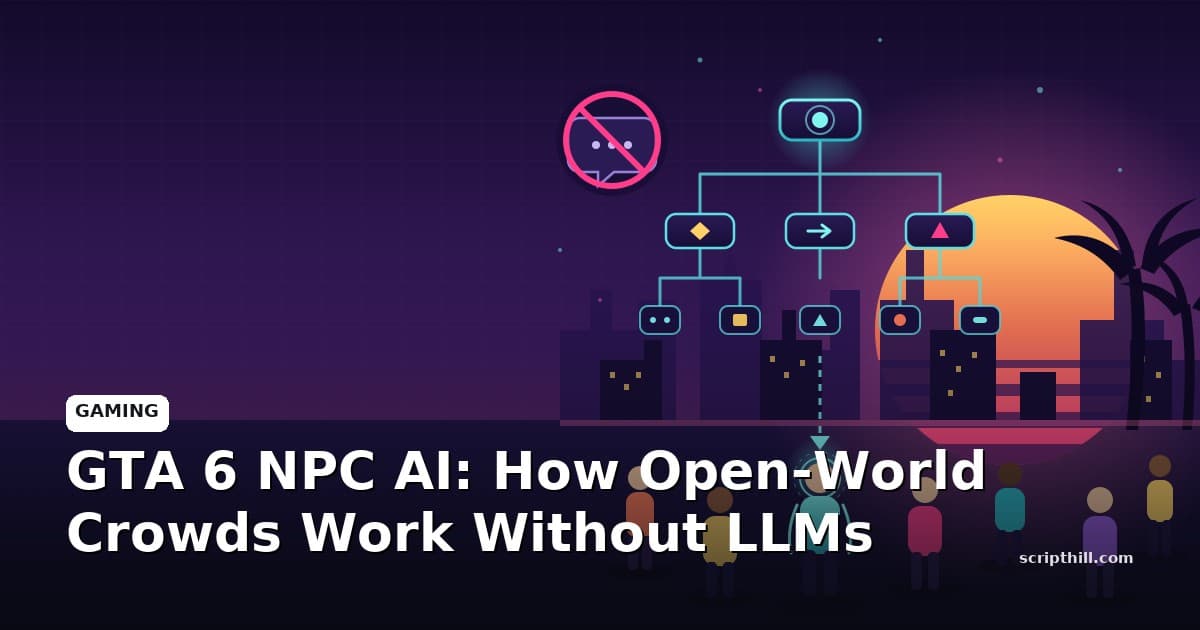
Rockstar hasn't said GTA 6 uses generative AI for its NPCs, and nothing public suggests ChatGPT-style pedestrians are wandering Vice City. The dense crowds in the trailers don't need it. Open-world crowds are built from cheap, authored systems. Pedestrians are spawned around the player, routed over navigation meshes and kept apart by steering. Scripted scenarios and reaction logic give them something to do, and their detail drops off with distance. That's almost certainly what "GTA 6 NPC AI" means in practice.
The game launches November 19, 2026, on PS5 and Xbox Series X|S. Until people play it, nobody outside Rockstar can verify how its pedestrians behave.
Does GTA 6 use AI NPCs?
Every "GTA 6 has AI NPCs" post you've seen this week is guesswork. Neither Rockstar nor Take-Two has said the game uses generative AI or large language models for its characters. Take-Two's latest earnings call reconfirmed the November 19 date and said nothing about chatbot pedestrians.
Most of the confusion comes from one word. When game developers say "AI," they mean the logic that decides what a character does next, not a generative model. That logic comes in a few familiar forms:
- Finite-state machines flip an NPC between idle, flee and fight.
- Behavior trees spread across the industry after Halo 2.
- F.E.A.R.'s soldiers used goal-oriented action planning to chain actions toward a goal.
- The Sims picks activities by utility scoring against each character's needs.
All of these are authored. A designer writes the rules, so the same situation produces the same behavior, and QA can reproduce a bug, fix it and confirm the fix holds. Studios lean on that predictability when thousands of pedestrians share one frame budget and any one of them might be standing next to a cop when you open fire. By that definition, GTA 6 has plenty of NPC AI. It just isn't a chatbot.
A crowd faked around the camera
Most of the people you pass in Vice City exist only because you're about to see them. Before you turn onto a busy street, while buildings still block your view, the engine spawns pedestrians in a ring just past the edge of the camera and sets them walking toward you. The ones from the previous block get removed once they're behind you and far enough away that you won't notice.
Data decides who appears, not anyone's daily routine. GTA games use population files that set which pedestrian types show up in each zone at each time of day. San Andreas's popcycle data is the well-known example. Weather shifts the mix too, so a rainy downtown night thins out while a sunny beach afternoon fills up.
Simulation level of detail splits the visible crowd further. The person brushing past you gets full animation and frequent decision updates, while figures down the block update less often and run simpler movement. Nobody is tracking where any of them sleeps or works.
Even with those shortcuts, scale costs real hardware. Assassin's Creed Unity packed its Paris streets and paid for it in performance at launch. IO Interactive's GDC talk on Hitman: Absolution's crowds became a reference because making big crowds cheap took careful engineering.
How pedestrians find their way
A pedestrian's walk to the corner store is a stack of cheap systems, each solving one narrow problem. The route comes first. Walkable space is baked into a navigation mesh, a simplified map of sidewalks, crosswalks and plazas, and an A* search finds a path across it. That path ignores everyone else on the street.
Steering handles them. Reynolds-style behaviors like seek, arrive and separation nudge each walker along its route. Velocity-obstacle methods such as RVO and ORCA have every agent pick a velocity that won't hit its neighbors in the next moment. When hundreds of people share a destination, like a stadium exit, a flow field computes one direction grid the whole group reads instead of running A* per person.
None of it looks human until animation takes over. Motion matching picks the clip that best fits the requested movement, and procedural physics handles stumbles and shoves. Rockstar has used NaturalMotion's Euphoria for that since GTA IV, which is why a sideswiped pedestrian staggers instead of playing a canned fall.
If you want to build this yourself, start with Unreal Engine 5's Mass Entity and MassAI (the stack behind the Matrix Awakens city demo), Unity DOTS, the Recast/Detour navmesh libraries and behavior-tree plugins.
Scenarios and reactions sell the illusion
Most of what reads as intelligence on a GTA street is set dressing someone placed by hand. Scenario points, a type of smart object, are spots tagged with an activity: smoke here, lean on this railing, fish off this pier, use this ATM. An idle pedestrian claims a free point nearby, plays its animations and moves on. GTA V was full of them, and they did more for the city's sense of purpose than any decision logic did.
The other half is reaction. Each NPC runs a perception check for stimuli like gunfire, a car mounting the curb or a crime in view. A lookup then picks the response, which might be to flee, cower, film it on a phone, call the police or fight back. Vary that table by pedestrian type and the crowd starts to seem like it has opinions.
RDR2 pushed this further. You could greet or antagonize almost anyone, and townsfolk remembered what you'd done there last time. That's the reasonable floor for whatever Rockstar ships next. Watch Dogs found a cheaper trick. Its profiler stamped every passerby with a generated name, a job and an odd personal detail, and players read that as depth.
Reaction depth matters more than headcount. A thousand pedestrians who ignore a gunshot feel emptier than two hundred who scatter, film it and phone it in.
Why studios keep LLMs out of crowds
Even a free language model would solve only the smallest part of the crowd problem. An LLM can write a line of dialogue. It can't route a pedestrian across a crosswalk, keep two hundred people from colliding or decide who spawns on the next block. Every system above would still have to run underneath it.
Then there's the cost. A console's GPU is already busy drawing Vice City, which leaves little headroom for running a model locally. Moving inference to the cloud adds a network round trip, and a bystander has only a fraction of a second to flinch at a gunshot. The cloud also bills every exchange, across tens of millions of players.
Control is the bigger problem. QA can't test a line nobody wrote, and ratings boards rate actual content. A satirical, adult-rated game already has pedestrians saying provocative things on purpose, and a model improvising past that line is a legal and PR risk. Generated text also needs a voice. Synthetic voices run straight into actors' unions, and AI protections were central to the 2024–25 SAG-AFTRA video game strike.
| Cost per player | Latency | Determinism/QA | Content safety | Voice | Scale | |
|---|---|---|---|---|---|---|
Scripted/systemic NPCs | Paid once, in development | Instant, every frame | Same input, same result; testable | Every line reviewed | Recorded by actors | Thousands at once |
LLM-driven NPCs | Ongoing, per conversation | Noticeable delay per reply | Varies run to run; hard to test | Filtered, can still slip | Synthetic, union friction | A handful |
A GTA 6 pedestrian who sounds improvised is most likely drawing on a large pool of recorded lines picked by context. Generative NPCs do exist, but only in small showcases. Nvidia's ACE demos put one conversational character behind a counter. inZOI runs a small model on the player's own machine to shape its residents. Inworld-style tech demos let you hold a remembered conversation with one or two characters. Each spends its whole budget on a few characters you choose to approach, which is the opposite of a street full of strangers walking past.
What to expect on November 19
Packed streets in the trailers say almost nothing about how GTA 6's pedestrians think. Trailer shots are directed, and crowd density is a dial. A team can raise the population of one street for one camera move without touching the underlying systems. The real evidence will come from an ordinary afternoon of play, with no camera crew.
If Vice City feels more alive than Los Santos, bet on the unglamorous explanations. Rockstar can author more animations, voice lines and scenarios, and it can sharpen the perception and reaction logic. Current-gen CPU and memory headroom also lets the game keep more people at higher detail closer to you. Hand-built detail at enormous scale has always been Rockstar's strength, and none of it needs a language model.
Tests for your first session:
- Fire a shot on a busy street and watch how far the panic travels. That shows the radius of the perception system and whether distant pedestrians react at all.
- Walk two blocks away, then come back. If the same people are still there, the game tracks them beyond the despawn ring. New faces mean it doesn't.
- Commit a crime in plain view. Whether bystanders film you, call police or step in shows how deep the reaction logic goes.
- Skip from noon to 3 a.m., then wait for rain. A crowd that thins and changes type shows the zone and time-of-day population rules at work.
- Drive fast and watch the screen edges. Pedestrians appearing out of nowhere show how tightly the spawn ring is drawn.
Sources
Want more from ScriptHill in Google? Add us as a preferred source